

How to Choose Between Hard Turning and Normal Cylindrical Grinding?
You have a hardened steel part that needs a perfect finish. You are stuck deciding between a lathe and a grinder. Making the wrong choice costs time and ruins your profit margin.
Choose hard turning for complex shapes, small batches, and eco-friendly dry cutting where IT5-IT6 tolerances are acceptable. Select cylindrical grinding for long, thin shafts, large batches, and when you need sub-micron precision or finishes better than Ra 0.2µm. Hard turning offers faster setup, while grinding ensures ultimate stability.

At J&M Machine Tools, we sell both CNC lathes and cylindrical grinders. We do not have a bias. We just want you to use the right machine for the job. Over the last 12 years, we have helped shops in 26 countries make this decision. Here is how we break down the choice based on real production needs.
What Is the Difference in Material Removal Mechanism Between Hard Turning and Grinding?
You might think they do the same thing. But the way they attack the metal is completely different, and this changes how you manage the heat and the stress.
Hard turning uses a single-point tool to shear metal into chips, keeping heat in the chip. Grinding uses an abrasive wheel to cut, plow, and rub the surface. Turning relies on mechanical force and plastic deformation, while grinding relies on friction and micro-abrasion, requiring coolant to manage heat.

We need to look at the physics to understand the difference. Hard turning functions like traditional turning, but the material is much harder, usually over 45 HRC. We use a single-point cutting tool, typically Polycrystalline Cubic Boron Nitride (PCBN)1 or ceramic. The tool has a sharp edge. It penetrates the steel and removes material through shearing. This creates a focused point of plastic deformation. The chip breaks away cleanly. The beauty of this is heat management. About 80% to 90% of the heat goes into the chip, leaving the part relatively cool. This preserves the microstructure of your workpiece.
Grinding is different. It uses a high-speed rotating wheel made of thousands of tiny abrasive grains. These grains do not just cut. They perform three actions: cutting, plowing, and rubbing. Some grains slice the metal, but others just push it or rub against it. This friction generates immense heat. Unlike turning, this heat likes to soak into the workpiece. You almost always need flood coolant to prevent thermal damage. So, hard turning2 is a "shearing" process that is fast and cool. Grinding is an "abrading" process that is slow, hot, and precise.
Why Is Hard Turning Often More Cost-Effective for Small Batch Production?
Small jobs kill profit if the setup takes too long. You need a process that starts making chips immediately, without spending hours calibrating a machine or dressing a wheel.
Hard turning is cheaper for small batches because it runs on standard CNC lathes with short setup times. It eliminates expensive grinding wheels and dedicated fixtures. You can machine multiple features in one clamping, reducing handling time, and the dry chips are easier to recycle than grinding sludge.
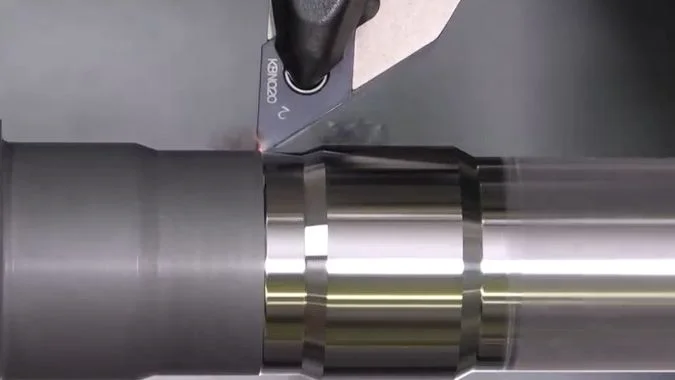
Money matters in every shop. When we look at small to medium batches, hard turning almost always costs less. First, look at the machine investment. A CNC lathe typically costs about 1/3 to 1/2 the price of a cylindrical grinder. You save capital immediately.
Second, look at the setup. Grinding requires complex calibration. You have to dress the wheel to the perfect shape and balance it. You often need specific fixtures for each part. Hard turning uses standard holders. You change a tool, load the program, and go. The changeover takes minutes, not hours.
Third, the process is streamlined. Hard turning allows you to "turn instead of grind." You can finish the OD, ID, face, and grooves in one clamping. You do not need to move the part to a different machine. This reduces labor and handling errors.
Finally, think about the environment. Hard turning is often a dry process. You do not need expensive coolant systems or waste disposal for sludge. The dry chips are clean and easy to recycle. This makes the whole operation cleaner and lowers your utility bills significantly compared to the energy-hungry grinding process.
| Feature | Hard Turning | Cylindrical Grinding |
|---|---|---|
| Setup Time | Short (Minutes) | Long (Hours) |
| Machine Cost | Low (1/3 of Grinder) | High |
| Coolant Needs | None (Dry Cutting) | Essential (Flood Coolant) |
| Waste Type | Clean, Recyclable Chips | Toxic Grinding Sludge |
How Do Surface Finish and Tolerance Capabilities Compare Between Hard Turning and Grinding?
You need to hit a specific number on the blueprint. If you miss the tolerance, the part is scrap. You must know the absolute limits of each machine type.
Grinding wins on ultimate precision, achieving tolerances of IT4 and roughness below Ra 0.1µm. Hard turning reaches IT5–IT6 and Ra 0.2–0.8µm, which is sufficient for most transmission parts. Grinding is the choice for mirror finishes, while hard turning fits standard high-precision needs.
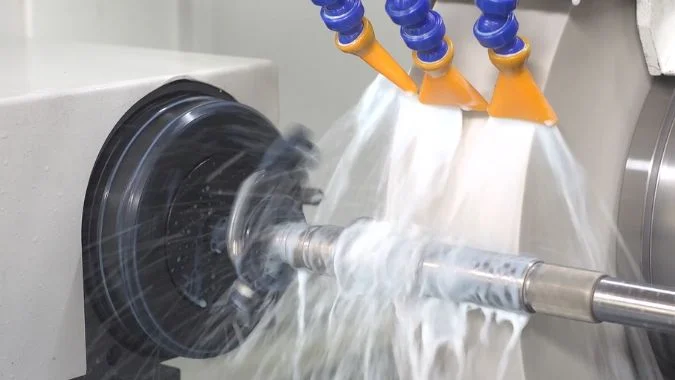
This is usually the deciding factor for our high-end clients. External cylindrical grinding3 is still the king of precision. If your print calls for dimensional tolerances at the sub-micron level (≤1μm) or IT4 grade, you must grind. If you need a "mirror" finish with a roughness (Ra) consistently below 0.1μm, you must grind. The abrasive nature of the wheel creates a random, cross-hatch texture that is incredibly smooth. The process is extremely stable, offering high Cpk values over long production runs.
Hard turning has improved a lot. With a rigid machine and quality PCBN tools, we can hit IT5 or IT6 tolerances. We can achieve a surface roughness of Ra 0.2–0.8μm. For 80% of parts, like gears, drive shafts, or bearing seats, this is good enough. However, turning leaves a microscopic spiral feed line on the part. While the numbers look good, the texture is different.
Also, hard turning can induce compressive residual stresses on the surface. This actually improves the fatigue life of the part, which is a hidden bonus. But for absolute roundness (within 0.5 microns) and true mirror finish, grinding remains the only reliable option.
How to Determine If Your Workpiece Geometry Favors Turning or Grinding?
The shape of your part often makes the decision for you. Some shapes are impossible to grind efficiently, while others are impossible to turn without causing vibration.
Choose hard turning for complex geometries with steps, contours, and tapered surfaces that need single-setup machining. Choose grinding for long, thin shafts (high length-to-diameter ratio) or thin-walled parts that distort easily. Turning handles profiles best, while grinding excels at straight, stable cylinders.

Look at the drawing of your part. The geometry tells you which machine to buy. If the part is complex, use hard turning. Does it have steps, tapers, grooves, threads, or spherical contours? A lathe can make all these features with one continuous tool path. You can program any contour you want. A grinding wheel is wide and flat. It cannot easily get into tight corners or cut complex curves without a special, expensive formed wheel. Turning gives you the flexibility to machine complex profiles and non-circular shapes like cams in one go.
However, if the part is structurally weak, use grinding. Think of a long, thin shaft or a thin-walled sleeve. We call this a high length-to-diameter ratio4. If you push a turning tool against it, the cutting force will bend the part. The middle of the shaft will end up thicker than the ends due to deflection. Grinding exerts very little cutting pressure. It does not push the part away. It grinds a straight, true cylinder every time without distorting thin walls. If you cannot rotate the part easily or have highly interfering surfaces, grinding might be your only physical option.
Conclusion
Choose hard turning for speed, eco-friendly savings, and complex shapes in small batches. Stick to grinding for long shafts, delicate thin walls, and when you need absolute mirror-finish precision.
-
Explore this link to understand the applications and benefits of PCBN in machining, enhancing your knowledge of cutting tools. ↩
-
Discover the benefits of hard turning, including efficiency and heat management, to improve your machining processes. ↩
-
Explore this link to understand why external cylindrical grinding is essential for achieving high precision and superior surface finishes. ↩
-
Learn about the significance of high length-to-diameter ratio and its impact on machining processes for better design decisions. ↩

Chris Lu
Leveraging over a decade of hands-on experience in the machine tool industry, particularly with CNC machines, I'm here to help. Whether you have questions sparked by this post, need guidance on selecting the right equipment (CNC or conventional), are exploring custom machine solutions, or are ready to discuss a purchase, don't hesitate to CONTACT Me. Let's find the perfect machine tool for your needs.