

How to Choose Between External and Internal Whirling Machine?
Choosing the wrong whirling method can cause poor accuracy, unstable cutting, wasted cost, and delayed delivery. The key is matching the machine to the screw.
Internal whirling is better for high-precision ball screws, fine surface finish, and stable pitch accuracy. External whirling is better for large-diameter screws, large-lead threads, multi-start threads, rough machining, and workpieces that cannot pass through the internal spindle or cutter head bore.
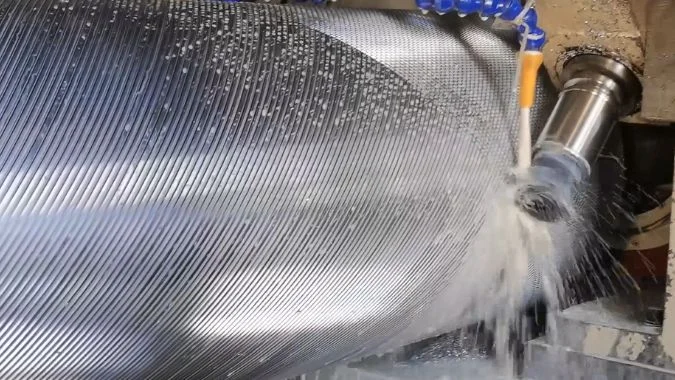
The choice between external and internal whirling should be based on workpiece diameter, required accuracy, lead angle, surface finish, tool structure, and production cost. Internal whirling usually gives better surface finish and pitch accuracy because the cutter head structure creates more balanced cutting force and smoother chip evacuation.1 It is more suitable for high-precision ball screws and precision lead screws. External whirling has a wider processing range because the workpiece does not need to pass through the spindle bore. It is more suitable for large-diameter screws, heavy shafts, large-lead threads, and multi-start threads. A simple rule can be used first. If the workpiece cannot pass through the internal whirling bore, external whirling is required. If the workpiece can pass through and high transmission accuracy is required, internal whirling is usually the better choice.
What Are the Fundamental Differences in Working Principles Between External and Internal Whirling?
The two methods both machine screw threads, but their tool positions, force directions, loading limits, and accuracy behavior are very different.
External whirling cuts around the outside of the workpiece with an external cutter head. Internal whirling requires the workpiece to pass through the spindle or cutter head bore, while tools arranged on the inner circumference cut the thread with more balanced force and higher stability.
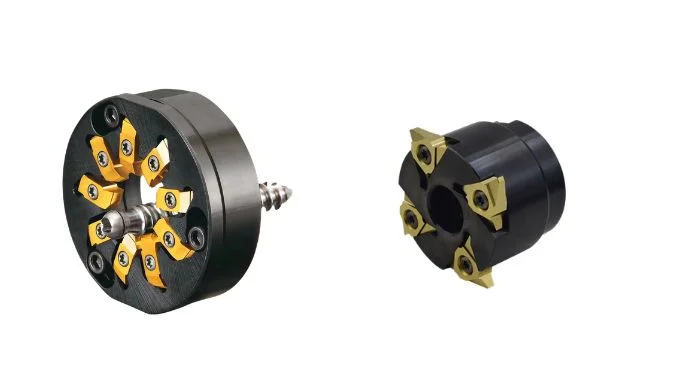
Internal whirling uses a cutter head with tools arranged on the inner circumference. The workpiece passes through the spindle bore or the cutter head bore. The cutter head rotates, and the tools cut the thread profile with a large envelope angle. This structure gives a more balanced cutting force. The force is not concentrated strongly on one side of the screw. This helps reduce bending, vibration, and thermal error. It also supports better pitch accuracy and better surface finish.
External whirling cuts from the outside of the workpiece. The cutter head rotates around the outer surface. The workpiece is usually supported by a chuck, tailstock, center rest, or special fixture. This structure is more open. It does not require the workpiece to pass through a spindle bore. Because of this, external whirling can process much larger diameters and heavier workpieces.
| Item | Internal whirling | External whirling |
|---|---|---|
| Tool position | Tools are arranged inside the cutter head | Cutter head works from the outside |
| Workpiece loading | Workpiece passes through the bore | Workpiece is clamped externally |
| Force condition | Balanced and stable | More eccentric and fluctuating |
| Diameter limit | Limited by spindle or cutter head bore | Limited by bed span and support rigidity |
| Lead angle range | Usually limited to about 12–14 degrees | Often adjustable around ±40 degrees |
| Main advantage | High precision and fine finish | Large size and high flexibility |
The tool system also changes the final result. Internal whirling can produce high accuracy only when the tool structure is accurate. If conventional welded carbide inserts are used and only one forming tool is clamped, tool marks may become coarse. If multiple forming tools are installed without precise alignment, the tooth profile centerline may not match the installation reference. This reduces tooth profile accuracy. Indexable whirling tools are often used to improve multi-tool forming, surface quality, and profile consistency. External whirling has lower bore restrictions and larger angle freedom, but it needs strong support and good vibration control.
What Types of Screws and Workpieces Require an External Whirling Machine?
Some screws cannot be processed by internal whirling because the workpiece diameter is larger than the whirling ring. In this case, structure decides the process.
External whirling is required for large-diameter screws, heavy shafts, large-lead threads, multi-start threads, rough threads, annular grooves, and workpieces that cannot pass through the whirling ring of an internal whirling machine.
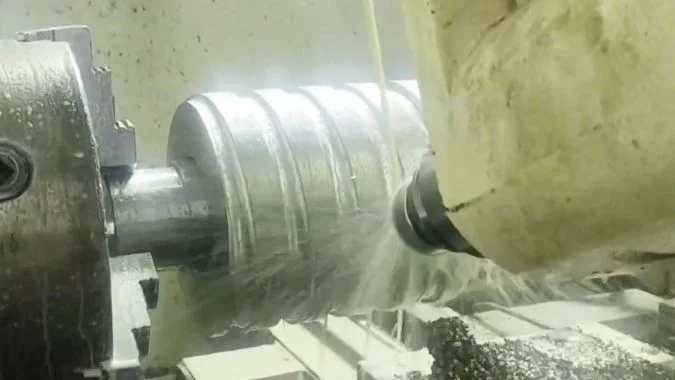
The most important reason for choosing external whirling is diameter. Internal whirling has a hard mechanical limit. The workpiece must enter the spindle bore or the cutter head bore. Standard internal whirling equipment is often limited to about Φ100 mm.2 Some custom equipment can go larger, but the size is still restricted by the bore structure. Even special structures rarely exceed about Φ200 mm in many practical cases. Large-diameter workpieces cannot be loaded physically, so internal whirling cannot be used.
External whirling does not have this bore limit. The tool cuts on the outside of the workpiece. The workpiece only needs stable support at both ends or along the length. The processing diameter depends mainly on the machine bed span, cutter head travel, tool structure, and support rigidity. External whirling systems can cover diameters from about Φ46 mm to much larger sizes.3 Special external milling or whirling mechanisms can be mounted on heavy-duty horizontal lathes to machine threads and annular grooves on diameters of Φ2000 mm or more.4
External whirling is also the first choice for large lead angles and multi-start threads. The lead angle of external whirling can often be adjusted by about ±40 degrees.5 This is useful for special transmission screws, screw shafts with high helix angles, and large-pitch structures. Internal whirling is usually limited to around 12–14 degrees because of the bore structure and tool envelope.6 If the inner bore is enlarged only to increase the lead angle, over-cutting of the tooth profile may occur. This can reduce profile accuracy. For this reason, external whirling is often used when the main challenge is workpiece size, lead angle, or process flexibility rather than ultra-high pitch accuracy.
Why Is Internal Whirling the Preferred Choice for High-Precision Ball Screw?
High-precision ball screws need stable raceway geometry, low pitch error, and smooth preload. Unstable cutting force can quickly reduce motion quality.
Internal whirling is preferred for high-precision ball screws because it provides balanced cutting force, low screw deformation, smooth chip evacuation, low temperature rise, stable raceway profile, better pitch accuracy, and high machining efficiency.
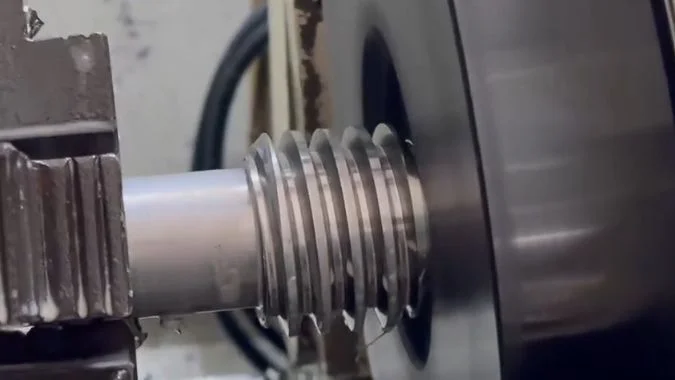
High-precision ball screws require more than a correct thread shape. The raceway must have stable pitch, consistent cross-section, good surface finish, and accurate pitch diameter. Internal whirling supports these requirements through its cutting structure. Multiple blades are arranged on the inner circumference of the cutter head. The blades remove material in sequence. The cutting process is gradual and stable. Cutting force is more balanced, so screw bending and vibration are reduced. This is important for long and slender ball screws because even small deformation can create lead error.
Heat control is another advantage. Traditional thread grinding can create local high temperature because grinding uses high-speed friction.7 In serious cases, surface burn or local softening can affect the raceway hardness and service life.8 Internal whirling removes chips quickly. Most of the cutting heat is carried away by the chips. The temperature rise of the workpiece is lower, and thermal deformation is reduced. This helps keep pitch accuracy stable over long machining lengths.
Internal whirling also improves profile consistency when the tool system is properly designed. High-hardness carbide forming tools can finish the thread raceway in one forming process.9 This helps maintain the cross-sectional shape and pitch diameter. After assembly, the ball screw can run more smoothly because dynamic preload torque fluctuation is smaller. This is important for CNC machine tools, automation equipment, precision stages, and other systems that need stable motion. Internal whirling can also improve production efficiency. Compared with slow turning and complex grinding, whirling can increase efficiency by several times or even more than ten times in suitable applications.10 It can also perform hard cutting directly on hardened lead screws when machine rigidity and tool quality are sufficient.
How Do Surface Finish and Pitch Accuracy Compare Between External and Internal Whirling?
Surface finish and pitch accuracy decide whether a screw can be used for precision transmission or only for general mechanical movement.
Internal whirling usually achieves better surface finish and pitch accuracy than external whirling. Internal whirling can often reach Ra 0.4–0.8 μm and GB/T 197 accuracy levels 4–6. External whirling is often around Ra 0.8–1.6 μm and suits level 7 or lower.
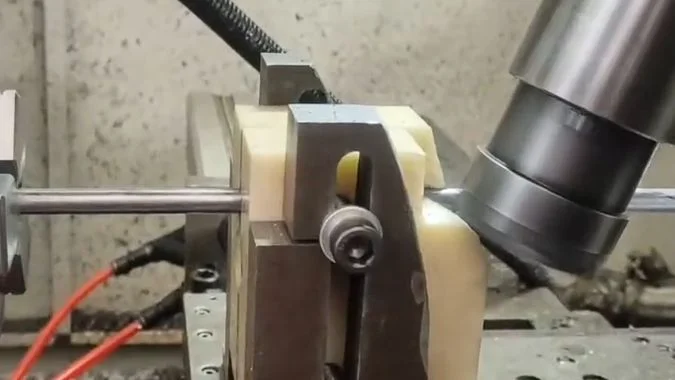
Internal whirling has a clear advantage in surface finish. The cutting process is more stable because the cutter head wraps around the workpiece and the cutting force is more balanced. The tool envelope stroke is longer, and the single-tooth cutting time is short and continuous. This reduces vibration, tool deflection, and tooth profile tearing. Under stable machining conditions, internal whirling can often reach Ra 0.4–0.8 μm. This level of finish is suitable for many precision ball screws and high-grade lead screws.
External whirling usually reaches Ra 0.8–1.6 μm. This is enough for many rough and medium-precision threads. It is also useful for large workpieces where internal whirling cannot be applied. However, external whirling is more likely to create vibration marks because the cutting force is more eccentric. Tool overhang, weak support, long workpiece length, and poor rigidity can all increase surface marks. These marks may not affect ordinary threads, but they can affect ball screw raceways and precision transmission parts.
Pitch accuracy also favors internal whirling. Because the internal cutter head surrounds the workpiece, the influence of cutting force fluctuation is lower. Transmission chain error has less effect on the final pitch. Internal whirling can often reach accuracy levels 4–6 according to GB/T 197 when the full process is controlled well. External whirling is generally more suitable for level 7 and below because eccentric cutting force can create periodic feed fluctuation and cumulative pitch error.
| Performance item | Internal whirling | External whirling |
|---|---|---|
| Surface roughness | About Ra 0.4–0.8 μm | About Ra 0.8–1.6 μm |
| Pitch accuracy | Often GB/T 197 level 4–6 | Usually level 7 or lower |
| Cutting force | Stable and balanced | Eccentric and more variable |
| Vibration risk | Lower | Higher under weak rigidity |
| Tool deflection | Smaller when tool system is correct | Easier to amplify |
| Tooth profile quality | Better consistency | More risk of tearing |
| Best application | Precision ball screws and lead screws | Large threads and rough machining |
The mechanical reason is direct. Internal whirling reduces the main sources of error. It lowers bending, controls thermal influence, improves chip evacuation, and keeps cutting force stable. External whirling has stronger side-force changes. These changes can cause vibration and feed fluctuation. Over a long thread, small changes become pitch inconsistency. For precision ball screws, this difference affects preload torque, running smoothness, noise, and service life. For large-diameter or large-lead parts, the size and lead-angle advantages of external whirling may be more important than fine accuracy. The final selection should balance precision demand and physical processing limits.
Conclusion
Internal whirling suits precision ball screws and high accuracy. External whirling suits large diameters, large lead angles, multi-start threads, and flexible heavy-duty machining.
-
"Effect of Cutting Conditions on Roughness and Cutting Force …", https://pmc.ncbi.nlm.nih.gov/articles/PMC12985697/. Manufacturing engineering research indicates that tool arrangements providing radially balanced cutting forces reduce workpiece deflection and vibration, contributing to improved surface finish in precision thread machining operations. Evidence role: mechanism; source type: research. Supports: the relationship between balanced cutting forces in internal whirling and resulting surface finish quality. Scope note: The source addresses general principles of balanced cutting forces rather than specifically comparing internal and external whirling methods ↩
-
"The Whirling Process for Internal Threads – Gear Solutions magazine", https://gearsolutions.com/features/the-whirling-process-for-internal-threads/. Technical specifications for internal whirling machines indicate that spindle bore diameter typically constrains workpiece size, with standard equipment accommodating workpieces in the range of 80-120mm diameter depending on machine configuration. Evidence role: general_support; source type: education. Supports: typical diameter limitations of internal whirling equipment based on spindle bore constraints. ↩
-
"Thread Whirling Machines – Leistritz Advanced Technologies Corp.", https://leistritzcorp.com/machine-tools/whirling-machines/. Machine tool manufacturers specify external whirling equipment with varying capacity ranges, with smaller machines handling workpieces from approximately 40-50mm diameter and larger systems accommodating substantially greater diameters limited primarily by machine bed dimensions and support rigidity. Evidence role: general_support; source type: other. Supports: the workpiece diameter ranges accommodated by external whirling equipment. ↩
-
"High Speed Thread Whirling from INDEX TRAUB – YouTube", https://www.youtube.com/watch?v=hY-5TbQLH8M. Heavy machinery manufacturing documentation describes specialized thread cutting attachments for large horizontal lathes used in processing oversized components such as large lead screws, with capabilities extending to workpiece diameters of multiple meters. Evidence role: case_reference; source type: other. Supports: the application of external thread cutting methods to very large diameter workpieces. ↩
-
"What is External Whirling? – JMCNCmachine", https://jmcncmachine.com/what-is-external-whirling/. Machine tool specifications for external whirling systems document lead angle adjustment ranges, with industrial equipment typically offering angular positioning capabilities suitable for threads with varying helix angles. Evidence role: general_support; source type: other. Supports: the angular adjustment capabilities of external whirling equipment for thread lead angles. Scope note: Specific angular ranges vary by equipment manufacturer and machine configuration ↩
-
"The Whirling Process for Internal Threads – Gear Solutions magazine", https://gearsolutions.com/features/the-whirling-process-for-internal-threads/. Analysis of internal whirling kinematics shows that the circular tool path and radial tool arrangement impose geometric limitations on achievable thread helix angles, with practical constraints arising from tool interference and cutting envelope considerations. Evidence role: mechanism; source type: research. Supports: geometric constraints that limit achievable lead angles in internal whirling due to tool envelope and bore geometry. ↩
-
"Analysis of Grindability and Surface Integrity in Creep-Feed …", https://pmc.ncbi.nlm.nih.gov/articles/PMC11051000/. Grinding research demonstrates that the sliding contact between abrasive grains and workpiece material generates significant frictional heat, with much of this thermal energy entering the workpiece and creating localized temperature elevations that can exceed material transformation temperatures. Evidence role: mechanism; source type: research. Supports: heat generation mechanisms in grinding processes and their effects on workpiece temperature. ↩
-
"Towards Understanding Subsurface Characteristics in Burn Process …", https://pmc.ncbi.nlm.nih.gov/articles/PMC10059046/. Metallurgical studies of grinding damage show that when surface temperatures exceed tempering thresholds, localized softening occurs through microstructural changes, resulting in reduced surface hardness and potentially decreased wear resistance in service. Evidence role: mechanism; source type: research. Supports: the metallurgical effects of excessive grinding temperatures on hardened steel surfaces. ↩
-
"Thread Whirling – What Is It, And How Does It Work? – GenSwiss", https://genswiss.com/whirldata. Manufacturing engineering texts describe form cutting as a process where the tool profile matches the desired workpiece geometry, enabling generation of complex shapes including thread forms in fewer passes than incremental cutting methods. Evidence role: general_support; source type: education. Supports: the use of form tools in thread manufacturing to generate complete profiles. ↩
-
"Thread Whirling – What Is It, And How Does It Work? – GenSwiss", https://genswiss.com/whirldata. Manufacturing process studies indicate that whirling operations can achieve significantly higher material removal rates than single-point threading methods, with productivity improvements varying based on thread specifications, material properties, and required accuracy levels. Evidence role: statistic; source type: research. Supports: comparative productivity advantages of whirling processes in thread manufacturing. Scope note: Specific productivity multiples depend heavily on application parameters and are not universally quantifiable ↩

Chris Lu
Leveraging over a decade of hands-on experience in the machine tool industry, particularly with CNC machines, I'm here to help. Whether you have questions sparked by this post, need guidance on selecting the right equipment (CNC or conventional), are exploring custom machine solutions, or are ready to discuss a purchase, don't hesitate to CONTACT Me. Let's find the perfect machine tool for your needs.