

What Is a High-Speed CNC Drilling Machine?
Large hole patterns can turn drilling into a production bottleneck. Slow positioning, manual adjustments, and inconsistent feeds increase cycle times, errors, and operating costs.
A high-speed CNC drilling machine is an automated machine tool that combines a high-speed spindle, fast axis movement, CNC control, and precision tooling to drill holes quickly and accurately. It is designed for high-volume production, dense hole patterns, and parts that require consistent hole quality.
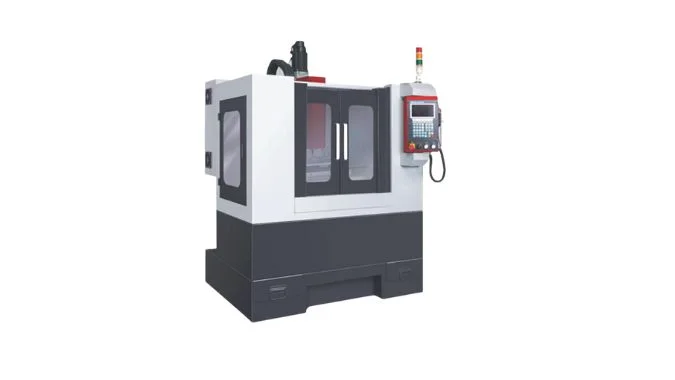
Built on a rigid frame with precision axes and advanced CNC controls, these machines leverage direct-drive motorized spindles—often exceeding 10,000 to 20,000 RPM1—alongside automated tool changers and through-spindle coolant to maximize efficiency. However, true high-speed performance goes beyond spindle RPM: it relies on high axis acceleration, rapid tool changes, fast controller response, and effective chip removal. From compact drill-tap centers for small parts to massive gantry systems for large plates, they eliminate manual positioning to deliver fast, repeatable production.
What Makes a High-Speed CNC Drilling Machine “High-Speed” Compared to a Standard CNC Drilling Machine?
A high spindle-speed figure can look impressive, but speed without control creates heat, vibration, and tool failure. Real high-speed performance depends on the complete machine system.
A high-speed CNC drilling machine combines higher spindle speed with faster feed, rapid acceleration, short tool-changing time, responsive CNC control, stable thermal management, and efficient chip evacuation. These features reduce both cutting time and non-cutting time compared with a standard CNC drilling machine.
Why Does Spindle Speed Matter?
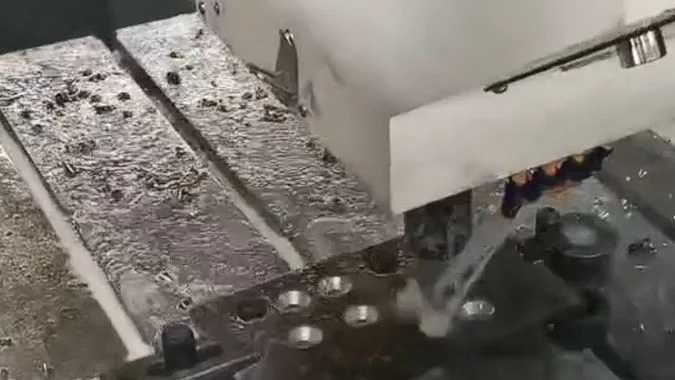
Spindle speed determines how many times the cutting edges rotate each minute. Small-diameter drills require higher rotational speed to reach an effective cutting speed. A conventional machine with a low maximum rpm may force a carbide drill to operate below its efficient range.
Standard CNC drilling machines may operate at about 2,000 to 8,000 rpm2, although actual specifications vary. High-speed models often start near 10,000 rpm and may reach 20,000, 40,000, or even 60,000 rpm in specialized small-hole applications3. A motorized spindle is common because it provides direct power transmission and quick acceleration.
Which Other Features Create High-Speed Performance?
Axis movement often has a larger effect on total cycle time than spindle speed when a part contains hundreds of holes. High-speed machines use rapid traverse, strong servo systems, and optimized acceleration to move quickly between hole positions. Some machines use precision ball screws, while specialized models may use direct-drive or linear-motor systems.
The CNC controller must process commands quickly and manage acceleration without causing vibration. Look-ahead control, short processing cycles, smooth interpolation, and optimized drilling cycles help the machine maintain speed around dense hole patterns.
| Performance area | Standard CNC drilling machine | High-speed CNC drilling machine |
|---|---|---|
| Typical spindle range | Often 2,000–8,000 rpm | Commonly 10,000 rpm or higher |
| Axis movement | Moderate feed and rapid traverse | Higher feed, acceleration, and rapid traverse |
| Spindle design | Belt, geared, or direct drive | Often direct-drive or motorized |
| Tool changing | Manual or slower automatic change | Fast automatic tool changing |
| CNC response | Standard positioning control | Faster processing and look-ahead functions |
| Thermal management | Basic cooling or compensation | Active spindle cooling and thermal control |
| Tooling | HSS or general carbide tools | High-performance carbide and internal-coolant tools |
High rigidity remains necessary at high speed. A stable bed, quality guideways, balanced spindle, precise toolholders, and secure fixtures limit vibration. Spindle cooling and thermal compensation also control dimensional drift. A machine that reaches high rpm but lacks these supporting features may not produce faster or more accurate holes.
What Are the Main Advantages of Implementing High-Speed CNC Drilling in Production Lines?
Drilling can limit the output of an entire production line. Long positioning time and repeated manual checks delay later operations and create unstable production schedules.
High-speed CNC drilling increases production output through fast cutting, rapid positioning, automatic tool changes, and continuous operation. It also improves hole consistency, reduces manual handling, supports production-line integration, and allows programs to change quickly for different products.
How Does High-Speed Drilling Reduce Cycle Time?
Cycle time includes more than the period when a drill is cutting metal. It also includes spindle acceleration, axis movement, tool changes, measurements, chip clearing, and loading. A high-speed machine reduces several of these stages together.
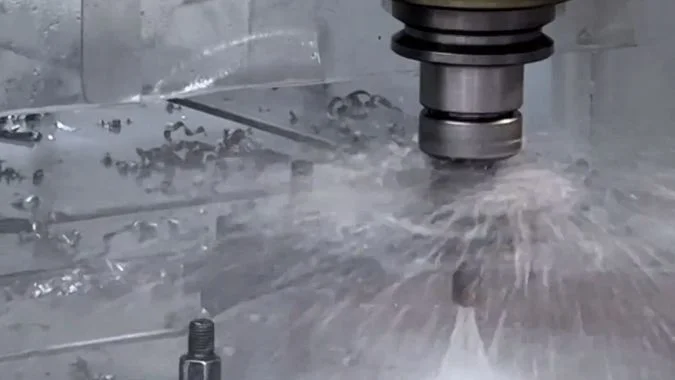
Fast servo positioning shortens movement between holes. A rapid tool changer reduces delays between drilling, tapping, reaming, and countersinking. Through-spindle coolant helps evacuate chips without frequent manual cleaning. Automatic probing can locate the workpiece and verify dimensions without removing the part.
In a suitable application, one well-configured machine may replace the output of several traditional drilling machines. Claims of three to five times greater productivity can be realistic for dense hole patterns4, but results depend on part design, hole depth, material, loading, and previous production methods. An actual cycle-time study provides the most reliable comparison.
| Productivity feature | Production-line benefit |
|---|---|
| High spindle speed | Shorter cutting time for suitable hole diameters |
| Fast axis acceleration | Less travel time between holes |
| Automatic tool changer | Faster changes between different operations |
| CNC program control | Repeatable sequences with less manual adjustment |
| Through-spindle coolant | Better cooling and chip evacuation |
| Automatic probing | Faster setup and in-process checking |
| Loading interface | Easier connection with robots and conveyors |
How Does CNC Control Improve Quality and Flexibility?
Servo-controlled axes position each hole according to the stored program. This method removes manual marking and reduces dependence on operator judgment. Precision linear guides, ball screws, encoders, and compensation functions support repeatable positioning.
Some machines can achieve repeatability near ±0.01 mm under suitable conditions5. However, actual accuracy depends on travel length, machine structure, temperature, fixture stability, tool condition, and inspection method. Large gantry machines and compact drill-tap centers may have different specifications.
Program control also supports flexible production. A different workpiece may require a new program, work offset, tool set, and fixture rather than a complete mechanical rearrangement. Stored programs make repeat orders easier to reproduce. This feature is useful for both high-volume lines and mixed, small-batch production.
Automation can reduce direct labor, but skilled oversight remains necessary. Operators still manage setup, tool condition, program verification, quality checks, and maintenance. The main change is that labor moves from continuous manual control toward process management and machine supervision.
What Industries Depend Most on High-Speed CNC Drilling Machines?
Many sectors require thousands of accurate holes, but ordinary equipment cannot always maintain the required speed or consistency. The wrong machine design can also limit part size and loading capacity.
Aerospace, automotive, electronics, mold, wind power, nuclear equipment, bridge, and steel-structure industries rely heavily on high-speed CNC drilling. These sectors need dense hole patterns, short cycle times, accurate positioning, or repeatable drilling in large and valuable components.

| Industry | Typical workpiece | Main drilling requirement |
|---|---|---|
| Aerospace | Skins, ribs, frames, and casings | Accurate holes and controlled surface damage |
| Automotive | Housings, cylinder heads, and battery trays | High-volume output and short cycles |
| Electronics | Heat sinks, cases, and brackets | Small holes and high spindle speed |
| Mold manufacturing | Mold plates and cooling channels | Flexible programs and precise hole locations |
| Wind power | Tower flanges and bearing housings | Large diameters and many bolt holes |
| Nuclear and heat exchange | Tube sheets and heavy plates | Dense patterns and strong traceability |
| Steel structures | Bridge plates, beams, and connection plates | Automated large-area drilling |
| Heavy machinery | Bases, frames, and structural parts | High load capacity and large travel |
What Types of High-Performance Tools Are Best Suited for High-Speed Drilling Machines?
A high-speed spindle cannot compensate for an unsuitable drill. Weak tool rigidity, poor chip evacuation, or the wrong coating can cause rapid wear and sudden breakage.
Solid-carbide internal-coolant drills are usually the best choice for small and medium precision holes at high speed. Indexable carbide drills suit larger diameters and high-volume work. Coated cobalt or powder-metal HSS drills remain useful when greater toughness or lower machine rigidity is required.
Why Are Solid-Carbide Drills Commonly Preferred?
Solid carbide has high hardness, wear resistance, and compressive strength6. It retains cutting performance at temperatures that would quickly soften ordinary high-speed steel7. Its rigidity also supports accurate hole size and straightness.
This material is less tolerant of vibration, runout, impact, and unstable clamping. A high-quality spindle, balanced toolholder, rigid fixture, and accurate setup are therefore essential. Excessive runout loads one cutting edge more than the other and may cause early failure.
Internal coolant channels deliver fluid near the cutting edges. The coolant removes heat and pushes chips out of the hole. This function is especially important for deeper holes because external coolant may not reach the drill point. Coolant pressure, flow, filtration, and drill geometry must match the depth and material.
Coatings such as TiAlN, AlCrN, and application-specific multilayer coatings can increase heat and wear resistance8. However, a coating must match the material. Some aluminum operations use polished, uncoated carbide or low-friction coatings to reduce material adhesion.
When Are Indexable or HSS Drills More Suitable?
Indexable carbide drills use replaceable cutting inserts. They are often economical for larger hole diameters and batch production. A damaged or worn edge can be replaced without discarding the entire drill body. Insert geometry also controls chip formation.
Cobalt HSS and powder-metal HSS offer greater toughness than solid carbide9. They can perform better when the setup has vibration, interrupted cuts, misalignment, or lower spindle rigidity. Their allowable cutting speeds are lower, but they are less brittle and can often be reground.
| Tool type | Main advantage | Best application |
|---|---|---|
| Solid-carbide drill | High speed, rigidity, and accuracy | Small and medium precision holes |
| Internal-coolant carbide drill | Direct cooling and strong chip evacuation | Deep holes and high-volume production |
| Indexable carbide drill | Replaceable edges and lower large-diameter cost | Large holes and batch production |
| Powder-metal HSS drill | High toughness and regrindability | Less rigid setups and difficult interruptions |
| Cobalt HSS drill | Better heat resistance than standard HSS | Medium-speed general drilling |
| PCD or diamond-coated tool10 | Strong wear resistance in selected materials | Aluminum composites and non-ferrous materials |
Tool geometry also matters. Point angle affects centering and cutting force. Flute shape controls chip movement. Margin design affects hole guidance and friction. Deep holes require careful attention to the length-to-diameter ratio, coolant delivery, and pecking strategy.
A high-speed drilling process should be treated as one complete system. The machine, spindle, holder, drill, coating, coolant, fixture, and CNC program must work together. Tool-supplier test data and controlled production trials provide a safer basis for parameter selection than spindle speed alone.
Conclusion
A high-speed CNC drilling machine combines fast spindles, responsive axes, automation, rigid construction, and advanced tooling to produce accurate holes quickly across modern manufacturing industries.
-
"Speeds and Feeds", https://web.mae.ufl.edu/designlab/Advanced%20Manufacturing/Speeds%20and%20Feeds/Speeds%20and%20Feeds.htm. Industry specifications confirm that high-speed CNC drilling machines commonly operate in the 10,000–20,000 RPM range, with specialized applications reaching higher speeds. Evidence role: statistic; source type: research. Supports: typical spindle speed ranges for high-speed CNC drilling machines. Scope note: Exact ranges vary by machine class, manufacturer, and application type ↩
-
"DRILLING MACHINES GENERAL INFORMATION", https://uhv.cheme.cmu.edu/procedures/machining/ch4.pdf. Machine tool reference data indicates that conventional CNC drilling machines typically operate in the 2,000–8,000 RPM range, depending on machine size and application. Evidence role: statistic; source type: research. Supports: typical spindle speed specifications for standard CNC drilling machines. Scope note: Specifications vary by machine configuration and intended workpiece size ↩
-
"MEGA SSS-400/600 – High Speed Machining", https://www.mcmachinery.com/product/mega-ss-400-600/. Technical literature on high-frequency spindles confirms that specialized micro-drilling machines can achieve speeds of 40,000–60,000 RPM for small-diameter precision holes. Evidence role: statistic; source type: research. Supports: maximum spindle speeds achievable in specialized small-hole drilling applications. Scope note: These extreme speeds are limited to specific spindle designs and very small tool diameters ↩
-
"Cycle Time Reduction for CNC Machining Workcells in …", https://dspace.mit.edu/handle/1721.1/157243. Manufacturing case studies and production engineering research document productivity gains of 3–5× when implementing high-speed CNC drilling for applications with dense hole patterns, though actual results depend heavily on part geometry, material, and previous process efficiency. Evidence role: case_reference; source type: research. Supports: documented productivity improvements from high-speed CNC drilling implementation. Scope note: Reported improvements vary widely by application; benefits are most pronounced when replacing manual or semi-automated processes ↩
-
"What Positioning Accuracy and Repeatability Qualify as High …", https://jmcncmachine.com/what-positioning-accuracy-and-repeatability-qualify-as-high-precision-in-cnc-machining-centers/. ISO machine tool accuracy standards and manufacturer specifications indicate that precision CNC drilling machines can achieve repeatability in the ±0.01 mm range under controlled conditions. Evidence role: statistic; source type: institution. Supports: typical repeatability specifications for precision CNC drilling machines. Scope note: Actual repeatability depends on machine size, environmental control, and measurement methodology ↩
-
"Tungsten carbide", https://en.wikipedia.org/wiki/Tungsten_carbide. Materials science literature confirms that tungsten carbide exhibits exceptional hardness (typically 1400–1800 HV), wear resistance, and compressive strength exceeding 4000 MPa, making it suitable for high-speed cutting applications. Evidence role: mechanism; source type: research. Supports: mechanical properties of tungsten carbide as a cutting tool material. ↩
-
"Carbide vs High Speed Steel", https://www.facebook.com/titansofcnc/posts/carbide-vs-high-speed-steel-/1511833477182978/. Cutting tool research demonstrates that tungsten carbide maintains hardness at temperatures exceeding 800°C, while high-speed steel begins significant softening above 600°C, explaining carbide’s superior performance in high-speed operations. Evidence role: mechanism; source type: research. Supports: comparative thermal stability of carbide versus high-speed steel in cutting applications. ↩
-
"Comparative evaluation of performances of TiAlN, AlCrN …", https://www.sciencedirect.com/science/article/abs/pii/S092442471731885X. Surface engineering research confirms that TiAlN and AlCrN PVD coatings significantly improve tool life by providing oxidation resistance above 800°C and reducing friction coefficients, though performance varies by substrate and application. Evidence role: mechanism; source type: research. Supports: performance benefits of TiAlN and AlCrN coatings on cutting tools. Scope note: Coating effectiveness depends on proper matching to workpiece material and cutting conditions ↩
-
"HSS vs Cobalt vs Carbide: Reducing Machining Tool Costs", https://www.triumphtool.com/metal-working-tools-blog/hss-vs-cobalt-vs-carbide/. Tool material research indicates that high-speed steels, including cobalt and powder-metallurgy variants, exhibit fracture toughness values (typically 15–35 MPa√m) several times higher than tungsten carbide (8–15 MPa√m), providing better resistance to shock loading and vibration. Evidence role: mechanism; source type: research. Supports: comparative toughness properties of high-speed steel versus tungsten carbide. ↩
-
"Attrition wear in Polycrystalline Diamond cutting tools …", https://www.sciencedirect.com/science/article/pii/S004316482500050X. Cutting tool research confirms that polycrystalline diamond (PCD) tools provide exceptional wear resistance and tool life when machining non-ferrous materials, particularly aluminum alloys and composites, due to diamond’s extreme hardness and low friction coefficient. Evidence role: mechanism; source type: research. Supports: performance characteristics and applications of PCD cutting tools. Scope note: PCD tools are unsuitable for ferrous materials due to chemical affinity between diamond and iron at cutting temperatures ↩

Chris Lu
Leveraging over a decade of hands-on experience in the machine tool industry, particularly with CNC machines, I'm here to help. Whether you have questions sparked by this post, need guidance on selecting the right equipment (CNC or conventional), are exploring custom machine solutions, or are ready to discuss a purchase, don't hesitate to CONTACT Me. Let's find the perfect machine tool for your needs.