
Why Is the Fixed-Beam GMC More Suitable for Machining Mold Steel?
Hardened mold steel creates high cutting resistance, heat, and chatter.1 An unstable gantry structure turns these forces into contour errors, damaged tools, and lengthy polishing work.
A fixed-beam gantry machining center suits mold steel because its stationary beam and columns create a short, rigid force path. High rigidity, strong damping, heavy-load capacity, and thermal symmetry support rough stock removal, deep-cavity milling, precise contours, and stable long-cycle finishing.
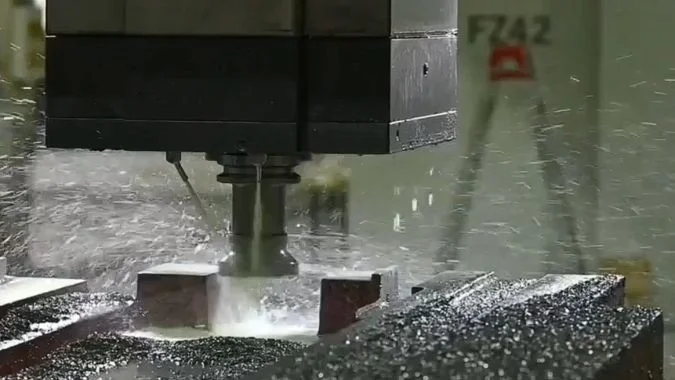
This stationary architecture provides a rock-solid foundation throughout the entire mold-making lifecycle. By eliminating dynamic beam deflection, it neutralizes cutting forces, chatter, deep-reach instability, and thermal drift.
Why Is High Structural Rigidity Crucial When Milling Hardened Mold Steels?
Hardened steel strongly resists the cutting edge. Any movement in the beam, ram, spindle, tool, fixture, or workpiece becomes a dimensional error on the mold surface.
High structural rigidity limits elastic deformation under heavy cutting forces. It keeps the commanded and actual tool paths closely aligned, suppresses chatter, protects brittle cutting edges, and preserves mold contour accuracy during roughing and finishing.
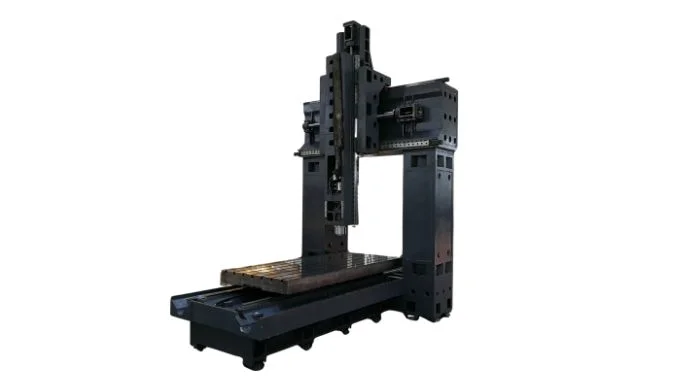
Hardened mold steel creates greater cutting resistance than aluminum or unhardened general steel. The force acts on the cutting tool, spindle bearings, ram, beam, columns, guideways, table, fixture, and workpiece. Every component forms part of one rigidity chain. A weak point anywhere in that chain permits elastic movement.
Elastic deformation often appears as tool deflection. The CNC system may command a specific depth of cut, but the tool and machine structure move away from the material under load. The actual depth then becomes smaller than programmed. When the cutting load falls, the system springs back. This repeated movement causes undercutting, overcutting, contour distortion, and inconsistent stock for later finishing.
A fixed beam creates a stable bridge between two columns. Unlike a lifting beam, it does not require vertical positioning joints or additional beam-moving mechanisms. This reduces potential deformation points. A thick ram and short spindle overhang further shorten the cutting-force path.
| Mold machining demand | Fixed-beam structural response | Production benefit |
|---|---|---|
| Heavy roughing | High bending and torsional stiffness | Larger stable material removal |
| Interrupted cutting | Rigid frame resists impact | Lower risk of insert chipping |
| Complex contour finishing | Stable spindle-to-table geometry | Better profile accuracy |
| Large mold block | Wide table and heavy bed support | Reduced workpiece-induced deformation |
| Long machining cycle | Consistent mechanical alignment | Lower dimensional drift |
| Deep cavity | Strong beam and ram support | Better stability with extended tools |
Rigidity also changes the machine’s dynamic behavior. A stiffer structure generally raises its natural frequencies.2 This can move structural resonance away from common tooth-passing and spindle excitation frequencies. The result is a wider stable cutting range and less risk of regenerative chatter.
High rigidity does not remove the need for correct tooling and parameters. Excessive tool overhang, weak clamping, worn spindle bearings, or unsuitable cutting data can still create vibration. The fixed-beam structure provides the foundation, while tooling and process control determine how fully that foundation is used.
How Does the High Chatter Damping of a Fixed-Beam GMC Improve Mold Surface Finish?
Chatter produces periodic waves across a mold cavity.3 Even when dimensions remain close to tolerance, these marks can require many hours of manual grinding and polishing.
High chatter damping absorbs cutting vibration before it grows into resonance. A stable tool-tip path reduces ripples, cutter marks, local overcutting, and roughness variation, improving mold finish while extending tool life and reducing polishing.
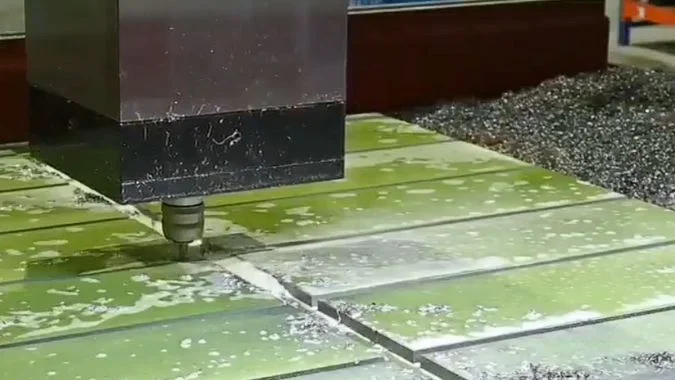
Rigidity and damping perform different jobs. Rigidity limits how far the structure moves under force. Damping removes vibrational energy after movement begins.4 A machine can be very rigid but still transmit vibration if its damping is poor. Mold machining requires both properties because hardened steel creates repetitive cutting impacts and high-frequency excitation.
Heavy cast-iron beds and gantry frames provide useful natural damping.5 Internal ribs, broad contact surfaces, and properly preloaded guideways distribute cutting forces through a large structure. Some machines use mineral casting, polymer concrete, damping fillers, or hybrid base structures to absorb additional energy.6 These materials convert part of the vibrational energy into low-level heat instead of reflecting it back toward the cutting zone.7
Stable damping protects trajectory fidelity. The CNC control may generate a smooth interpolation path, but vibration can prevent the tool tip from following it. The cutting edge then moves above and below the commanded surface, leaving periodic ripples. A well-damped fixed-beam structure keeps the physical tool path closer to the programmed path.
Tool life improves at the same time. Chatter creates repeated impact loading at the cutting edge. Carbide, ceramic, and PCBN tools are hard but relatively brittle.8 Repeated impact can cause micro-chipping, coating loss, or sudden fracture. A stable cut allows the edge to wear more uniformly, so surface quality remains consistent for longer.
The final roughness still depends on tool geometry, step-over, feed per tooth, spindle runout, tool balance, and workpiece hardness. Near-mirror mold surfaces may still require grinding, lapping, or polishing. However, better damping can remove the severe spiral and wavy defects that create most of the corrective work. In suitable mold applications, high-quality milling can substantially reduce later polishing and shorten delivery time.
Additional damping measures can support the machine structure. Hydraulic damping holders, unequal-pitch cutters, tuned dampers, servo notch filters, and spindle-speed optimization can address specific vibration frequencies. These methods are most effective when the basic machine, spindle, fixture, and tool system are already rigid and well maintained.
Why Is a Fixed-Beam GMC Superior for Deep Mold Cavity Milling with Long Tool Overhangs?
Deep ribs, narrow pockets, and steep cavity walls often require extended tools. As overhang grows, bending stiffness falls sharply and small cutting forces can produce large tool-tip movement.
A fixed-beam GMC provides a rigid spindle and ram foundation that limits the additional movement caused by long tools. This support reduces deflection, chatter, taper error, and edge failure during deep-cavity milling, although overhang must still be minimized.
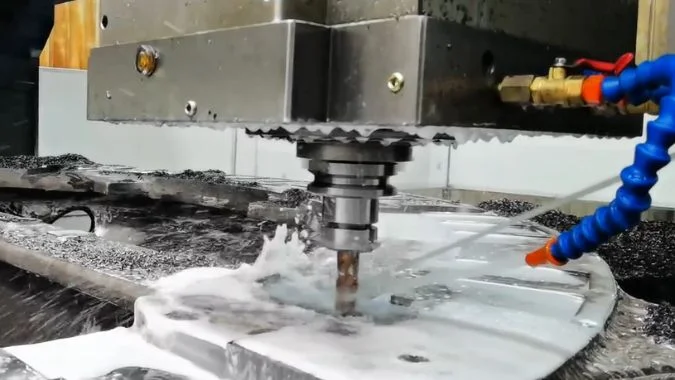
Tool overhang is one of the strongest influences on milling stability. A cutting tool behaves like a cantilever beam. Its bending deflection rises rapidly as unsupported length increases. In simplified beam behavior, deflection is related to the cube of overhang length.9 A modest increase in tool length can therefore cause a much larger increase in tool-tip movement.
Deep mold cavities make this problem difficult to avoid. The holder must clear cavity walls, ribs, and adjacent surfaces. A long end mill, ball-end mill, or extension holder may be required. The weak tool then becomes the most flexible part of the cutting system.
A fixed-beam GMC cannot make a long tool rigid, but it prevents unnecessary flexibility elsewhere. The stationary beam, reinforced columns, square ram, spindle bearings, and heavy table provide a stable reaction structure. If the machine body also deflected significantly, tool movement and structural movement would combine. The resulting chatter could make deep-cavity finishing impossible.
A strong ram is especially important. Box or square rams provide balanced rigidity against bending and torsion. Hydraulic or dual-cylinder balancing can support smooth vertical movement without allowing gravity to overload the feed mechanism. When the ram extends toward a deep cavity, the surrounding beam and guideway arrangement help maintain alignment.
Process strategy remains essential. The shortest usable tool should be selected for each cavity depth. Tapered neck tools or reduced-neck tools can provide clearance without making the full shank thin. Radial engagement should be controlled to keep cutting force stable. Trochoidal or dynamic milling can avoid sudden load increases in corners. Rest machining can use smaller tools only where larger tools could not reach.
Deep-cavity finishing also benefits from planned tool sequences. Roughing should leave a stable and even allowance. Semi-finishing should remove stock variation before the final pass. The finishing tool should not encounter unexpected heavy areas because these create deflection and visible surface transitions. A fixed-beam GMC supports the process, but correct tool length and stock control remain necessary.
How Does a Fixed-Beam Design Maintain Thermal Stability During Long Continuous Machining Cycles?
Mold machining can continue for many hours. Heat from the spindle, screws, guideways, motors, chips, and workshop gradually changes machine geometry and moves the tool center point.
A fixed-beam design improves thermal stability through a stationary, thermally symmetrical gantry frame and predictable heat paths. Active spindle and axis cooling, heat-source isolation, warm-up cycles, temperature sensors, and CNC compensation further limit long-term accuracy drift.
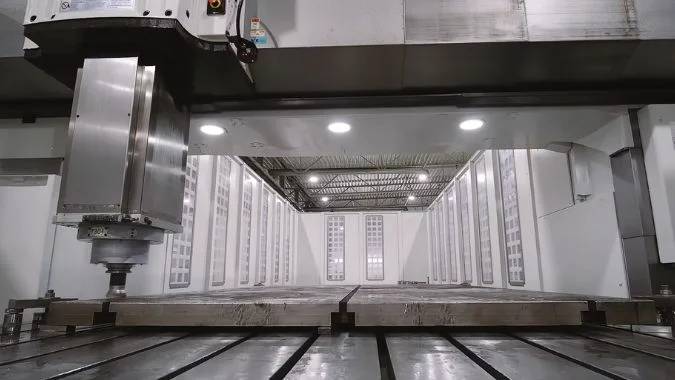
A fixed beam offers high thermal inertia because it forms part of a large stationary frame. The columns and beam can use symmetrical cross-sections and balanced rib arrangements. When temperature changes occur evenly, both sides expand in similar directions. This reduces angular distortion between the spindle axis and table.
A moving-beam structure introduces additional guideways, drives, and heat sources into the beam-positioning system. Changes in beam height can also alter thermal and mechanical conditions. A fixed beam removes this motion system and creates a more consistent geometry. The cutting-force path and thermal path remain more predictable throughout the machining cycle.
The table still moves, and the spindle, ram, ballscrews, motors, bearings, and guideways still generate heat. For this reason, structure alone cannot guarantee stability. High-performance GMCs use active temperature-control systems. Chilled oil or water may circulate around the spindle, motor, bearing housing, screws, or other critical components. Coolant temperature may also be controlled so that cutting fluid does not create a changing thermal gradient across the workpiece and machine.
Heat-source isolation improves stability further. Hydraulic stations, electrical cabinets, spindle chillers, and other heat-generating units can be positioned away from the main casting. Insulation can reduce heat transfer from motors into the spindle or beam. Efficient chip removal prevents hot chips from collecting on the table or bed.
Temperature sensors can monitor the spindle housing, columns, bed, screws, and ambient air. The CNC system uses a thermal model to estimate geometric movement and apply coordinate compensation. This function corrects residual error that mechanical symmetry and cooling cannot remove.
Warm-up is also important. A controlled spindle and axis warm-up brings the machine toward a stable operating temperature before precision finishing begins. Starting critical mold finishing on a completely cold machine can cause dimensions to drift as the structure warms. A constant workshop temperature, commonly controlled near 20°C with limited fluctuation for precision work10, provides an additional layer of protection.
Long-term stability also depends on casting quality. Resin-sand castings, stress relief, natural or artificial aging, and low-expansion materials help reduce residual stress and delayed deformation.11 These measures allow the fixed-beam GMC to maintain alignment during continuous operation and over its service life.
Conclusion
A fixed-beam GMC combines rigidity, damping, deep-cavity stability, and thermal control, making it highly suitable for heavy roughing and precise finishing of large mold-steel components.
-
"Hardened Steel Machining Tools | Carbide & CBN", https://www.exactaform.com/hardened-steel. Research on high-hardness steel machining confirms that hardened materials (typically above 45 HRC) generate significantly higher cutting forces and heat compared to annealed steels, with increased susceptibility to chatter vibration due to the material’s resistance to deformation. Evidence role: general_support; source type: research. Supports: the elevated cutting forces, thermal generation, and vibration tendency when machining hardened steel. Scope note: Studies vary in the specific hardness ranges and steel compositions tested ↩
-
"Machine", https://en.wikipedia.org/wiki/Machine. Structural dynamics theory establishes that natural frequency is proportional to the square root of stiffness divided by mass (f ∝ √(k/m)), indicating that increased stiffness raises resonant frequencies when mass remains constant or increases proportionally less. Evidence role: mechanism; source type: education. Supports: the positive correlation between structural stiffness and natural frequency. ↩
-
"Machining vibrations", https://en.wikipedia.org/wiki/Machining_vibrations. Machining dynamics research establishes that chatter—a self-excited vibration between tool and workpiece—produces characteristic periodic surface undulations at wavelengths corresponding to vibration frequency and feed rate, with wave amplitude proportional to vibration magnitude and orientation determined by dominant vibration mode direction. Evidence role: mechanism; source type: research. Supports: the generation of periodic surface waviness through chatter vibration. ↩
-
"Damping of Structures: Part 1 – Theory of Complex Damping", https://nehrpsearch.nist.gov/static/files/NSF/PB92197235.pdf. Mechanical vibration theory distinguishes stiffness (resistance to static displacement) from damping (dissipation of vibrational energy over time), with stiffness governing displacement magnitude under load and damping determining how quickly oscillations decay after excitation. Evidence role: definition; source type: education. Supports: the distinct mechanical functions of stiffness and damping in vibration control. ↩
-
"Damping Properties of Selected Steels and Cast Irons", https://stacks.cdc.gov/view/cdc/10399/cdc_10399_DS1.pdf. Materials research indicates that gray cast iron exhibits damping capacity 5-20 times higher than steel due to its graphite flake microstructure, which dissipates vibrational energy through internal friction at graphite-matrix interfaces, making it historically preferred for machine tool bases. Evidence role: general_support; source type: research. Supports: the superior damping properties of cast iron compared to other structural materials. Scope note: Damping performance varies significantly with cast iron grade, graphite morphology, and excitation frequency ↩
-
"Computer Aided Analysis of Vibration in Machine Tool and Design …", https://www.academia.edu/36982479/Computer_Aided_Analysis_of_Vibration_in_Machine_Tool_and_Design_of_Damping_System. Machine tool research demonstrates that polymer concrete (mineral aggregate bound with resin) can provide damping ratios 3-10 times higher than gray cast iron while maintaining comparable stiffness, attributed to viscoelastic energy dissipation in the polymer matrix. Evidence role: general_support; source type: research. Supports: the enhanced damping characteristics of polymer concrete and mineral-based composite materials. Scope note: Performance depends heavily on formulation, aggregate type, and resin selection, with some compositions showing temperature sensitivity ↩
-
"Damping Effects", http://faculty.washington.edu/parduino/DrLayer/Exercises/L-DEffects.htm. Vibration damping operates through irreversible energy transformation processes—including internal friction, viscoelastic deformation, and interfacial slip—that convert organized mechanical oscillation energy into disordered molecular motion (heat), preventing energy from being stored elastically and re-released into the vibrating system. Evidence role: mechanism; source type: education. Supports: the conversion of mechanical vibrational energy into thermal energy through damping mechanisms. ↩
-
"Improving the Fracture Toughness of Boron Carbide via Minor …", https://pmc.ncbi.nlm.nih.gov/articles/PMC11678037/. Cutting tool materials exhibit a well-documented hardness-toughness trade-off: while carbide, ceramics, and polycrystalline cubic boron nitride (PCBN) achieve hardness values of 1500-4500 HV enabling machining of hardened steels, their fracture toughness (2-8 MPa·m½) remains significantly lower than high-speed steel, increasing susceptibility to brittle failure under impact or vibration. Evidence role: general_support; source type: education. Supports: the inverse relationship between hardness and fracture toughness in advanced cutting tool materials. Scope note: Specific properties vary widely within each material category depending on composition and microstructure ↩
-
"DA6-BeamFormulas.pdf", https://engineering.purdue.edu/~ce474/Docs/DA6-BeamFormulas.pdf. Classical beam theory demonstrates that for a cantilever beam under point load, deflection is proportional to the cube of the beam length (L³), meaning that doubling the overhang increases deflection approximately eightfold under constant loading conditions. Evidence role: mechanism; source type: education. Supports: the cubic relationship between cantilever beam length and deflection. Scope note: This simplified relationship assumes uniform cross-section, linear elastic behavior, and neglects shear deformation effects ↩
-
"20 °C—A Short History of the Standard Reference Temperature …", https://pmc.ncbi.nlm.nih.gov/articles/PMC4654601/. International standards for dimensional metrology (ISO 1:2016) specify a reference temperature of 20°C (68°F), with precision manufacturing facilities typically maintaining ±0.5°C to ±2°C stability depending on required tolerances, to minimize thermal expansion effects on workpieces and measuring equipment. Evidence role: expert_consensus; source type: institution. Supports: the 20°C temperature standard for precision manufacturing and metrology. ↩
-
"The effect of artificial aging after multi-directional forging of …", https://pmc.ncbi.nlm.nih.gov/articles/PMC12259884/. Manufacturing engineering research confirms that thermal stress relief (heating to 500-650°C), natural aging (extended room-temperature storage), and artificial aging (thermal cycling) progressively reduce residual stresses in castings by 40-80%, decreasing long-term dimensional drift, though complete stress elimination is rarely achieved. Evidence role: general_support; source type: research. Supports: the reduction of residual stresses and dimensional instability through thermal and time-based treatments. Scope note: Effectiveness varies with casting size, geometry complexity, material composition, and process parameters ↩

Chris Lu
Leveraging over a decade of hands-on experience in the machine tool industry, particularly with CNC machines, I'm here to help. Whether you have questions sparked by this post, need guidance on selecting the right equipment (CNC or conventional), are exploring custom machine solutions, or are ready to discuss a purchase, don't hesitate to CONTACT Me. Let's find the perfect machine tool for your needs.