

What Are the Advantages of a CNC Gantry Drilling Machine Over Traditional Drilling Machines?
Manual drilling of large workpieces takes time and depends heavily on operator skill. Small positioning mistakes can quickly cause scrap, delays, and added costs.
A CNC gantry drilling machine offers higher automation, accuracy, flexibility, and output than a traditional drilling machine. Program control, servo positioning, multi-process machining, and production data tracking also reduce manual work and improve consistency across large parts and production batches.
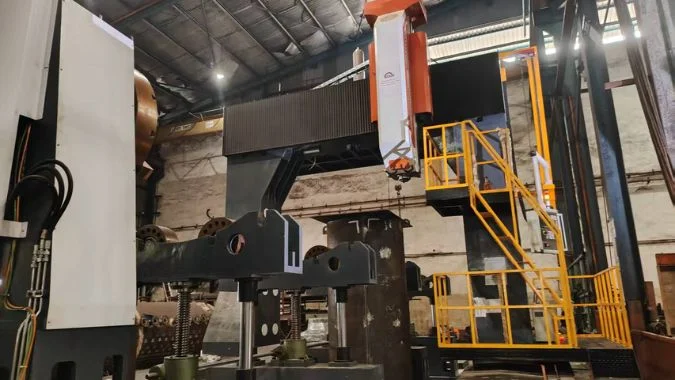
Traditional drilling machines remain useful for simple holes, repair work, and low-volume jobs. However, their performance often depends on manual marking, alignment, feed control, and repeated measurement. These steps become slow and difficult when a workpiece has hundreds of holes or a large drilling area.
A CNC gantry drilling machine replaces many manual actions with digital control. Its gantry structure covers a wide working area, while servo-driven axes move the spindle to programmed positions1. The machine can also combine drilling with tapping, reaming, boring, light milling, and other operations when its design supports them. This combination makes the equipment useful for tube sheets, flanges, steel plates, structural components, heat exchanger parts2, and other large workpieces.
How Does a CNC Gantry Drilling Machine Improve Automation and Machining Accuracy?
Manual marking and feed control create many chances for error. As hole counts rise, these small errors can damage an entire high-value workpiece.
A CNC gantry drilling machine improves automation through programmed movement, servo feed, automatic tool changes, cooling, and chip removal. It improves accuracy through digital positioning, closed-loop feedback, a rigid gantry structure, and single-clamping machining that reduces repeated setup errors.
How Does Program Control Replace Manual Operation?
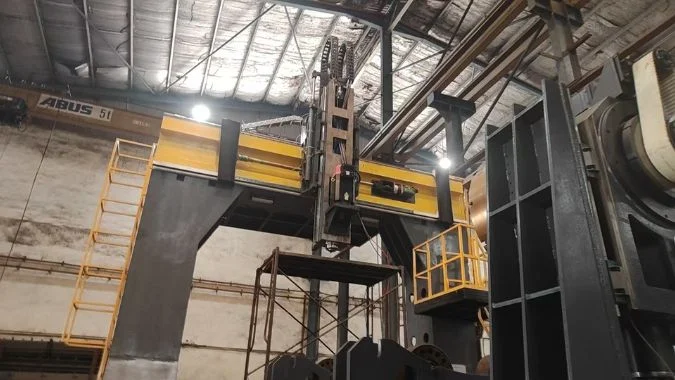
A traditional drilling process often starts with manual drawing interpretation. Workers mark hole positions, make center points, align the spindle, and control feed by hand. Every step depends on attention and experience. A large hole pattern makes this method tiring, slow, and open to mistakes.
A CNC gantry drilling machine uses a machining program to control the tool path, spindle speed, feed rate, hole depth, and operation order. Some systems can import CAD files or use graphical programming. The controller then converts the defined positions into machine movements. Once the workpiece and program have been checked, the machine can complete a long sequence with limited intervention.
Automation can also cover supporting actions. Depending on the machine configuration, the system may manage tool changing, cooling, lubrication, chip removal, tool setting, edge finding, and probing. These functions reduce idle time and remove repetitive manual work.
| Operation | Traditional drilling machine | CNC gantry drilling machine |
|---|---|---|
| Hole positioning | Manual marking and alignment | Programmed servo positioning |
| Feed control | Hand or basic mechanical feed | Controlled feed based on machining data |
| Tool changing | Manual | Manual or automatic, based on configuration |
| Cooling | Manually adjusted or basic supply | Program-controlled coolant supply |
| Chip handling | Frequent manual cleaning | Automatic or assisted chip removal |
| Process sequence | Controlled by the operator | Stored and executed by the CNC system |
What Machine Features Support Greater Accuracy?
Servo motors and position feedback allow the control system to compare commanded movement with actual axis movement. Higher-level machines may use linear scales for full closed-loop control3. Other machines use motor encoders and semi-closed-loop control. Both arrangements provide more repeatable movement than manual positioning when the machine is correctly built and calibrated.
The gantry frame also supports accuracy. A rigid crossbeam, heavy guideways, stable columns, and properly supported ball screws4 help resist cutting forces. Preloaded screws and guide systems can reduce backlash5. Temperature control and compensation can also limit thermal drift during long production cycles6.
Single-clamping machining provides another major benefit. A large plate with many holes may otherwise require repeated movement and realignment. Each new setup adds another chance for datum error. A gantry machine can reach a wide area while the workpiece stays fixed. This setup protects the relationship between all holes and machined features.
Actual accuracy depends on machine size, load, structure, control system, temperature, tooling, and maintenance. Figures such as ±0.01 mm may be possible on suitable machines under controlled conditions7, but model specifications must always guide the final comparison.
What Makes a CNC Gantry Drilling Machine More Flexible for Different Machining Applications?
Changing between large parts can require new marking, fixtures, and manual adjustments. Long setup times make small-batch and mixed production difficult to manage.
A CNC gantry drilling machine gains flexibility from programmable tool paths, a large working range, multi-axis movement, adjustable cutting parameters, and combined processes. Program changes allow the same machine to handle different hole patterns, materials, part sizes, and production quantities.
How Does Software Make the Machine More Adaptable?
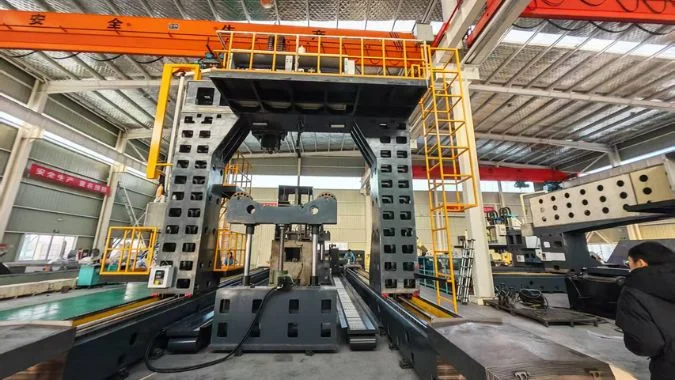
Program-driven production allows a machining pattern to change without a complete mechanical reset. A new part may only require another CNC program, revised work offsets, suitable tools, and a different fixture. Stored programs can also be recalled for repeat orders. This feature shortens changeover time and helps maintain the same process across separate production batches.
The machine can adjust spindle speed, feed rate, peck depth, coolant use, and tool sequence for different materials. Structural steel, stainless steel, aluminum, and other alloys require different cutting conditions. A CNC program stores these settings in a controlled form. Operators do not need to recreate every setting from memory.
A large gantry working area also supports different workpiece sizes. Some machines use a fixed table with a moving gantry. Others use different combinations of moving beams, columns, or worktables. The selected structure depends on part size, weight, required speed, and floor space.
Which Machining Processes Can Be Combined?
Many CNC gantry drilling machines provide more than basic drilling. Depending on spindle power, machine rigidity, controller functions, and tooling, one machine may perform center drilling, deep-hole drilling, tapping, countersinking, reaming, boring, and light milling. Some models can also machine grooves, sealing faces, and local reference surfaces.
This process combination reduces movement between machines. A flange, for example, may need a bolt-hole pattern, threaded holes, a sealing groove, and a finished reference face. Separate machines would require more handling and setup work. A suitable CNC gantry machine may complete several of these features in one clamping.
The equipment is commonly applied to tube sheets, flanges, boiler parts, wind power components, bridge plates, steel structures, construction machinery, and heavy equipment frames. However, flexibility does not mean that every model can perform every process. Spindle torque, tool capacity, axis travel, table load, and control options define the real operating range. Machine selection should therefore follow actual workpiece dimensions and process demands rather than a broad product label.
How Can a CNC Gantry Drilling Machine Increase Productivity and Reduce Labor Costs?
Slow positioning, repeated measurement, and manual tool changes create hidden production costs. These delays become much larger when every part contains dozens or hundreds of holes.
A CNC gantry drilling machine raises productivity by automating positioning, feed, tool changes, and multi-process machining. It lowers labor demand by reducing marking, handling, setup, inspection, and constant machine attendance, which can allow one trained worker to supervise more than one machine.
Where Does the Productivity Improvement Come From?
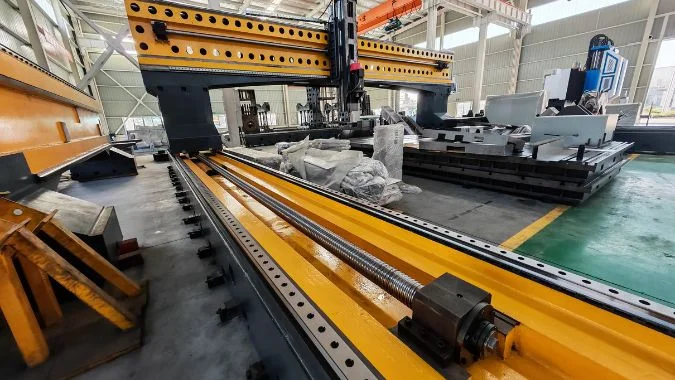
Automatic positioning removes much of the time spent aligning each hole. After one hole is completed, the gantry moves directly to the next programmed position. The process remains consistent across simple rows, circular patterns, and irregular hole layouts. Optimized path planning can also reduce unnecessary axis travel.
Process integration creates another saving. Drilling, tapping, countersinking, and reaming can take place in one setup when the machine has the required tools and functions. The workpiece no longer needs to move through several machines. Less movement means less waiting, fewer fixture changes, and a lower risk of handling damage.
Automatic tool changers can further reduce idle time. Quick-change fixtures, probing systems, and tool setters shorten preparation and adjustment. High-performance carbide drills or indexable U-drills8 may also raise cutting speed when the spindle and workpiece allow their use.
| Source of time saving | Production effect |
|---|---|
| Automatic hole positioning | Less marking, measuring, and manual alignment |
| Optimized tool path | Less non-cutting travel |
| Multi-process machining | Fewer machine transfers and setups |
| Automatic tool changing | Shorter delays between operations |
| Program reuse | Faster preparation for repeat orders |
| Continuous automatic cycles | Longer productive machine time |
| Online probing | Faster setup checks and error detection |
How Does Automation Change Labor Requirements?
Traditional drilling may require separate workers for marking, machine operation, material handling, and repeated inspection. Skilled operators must also adjust feed and monitor every hole. A CNC gantry machine moves much of this work into a standard digital process.
A trained operator still has important duties. These duties include program checking, setup, tool management, workpiece loading, process monitoring, measurement, and maintenance checks. However, constant hand control is no longer required. Stable processes and remote status displays may allow one worker to supervise several machines, especially during long drilling cycles.
Labor savings vary greatly between factories. Part complexity, batch size, loading methods, tool life, and automation options all affect the result. Claims of two to six times higher output or labor reductions above 50%9 may be possible in some high-volume applications. They should not be treated as fixed results. A time study using actual parts provides a more reliable estimate.
The largest gain often comes from combining several smaller improvements. Faster positioning, fewer setups, reduced scrap, less rework, and longer unattended cycles can lower the total cost per part even when cutting time alone changes only slightly.
Why Does Data Tracking Matter in CNC Gantry Drilling Machines?
Production problems are hard to correct when no reliable records exist. Missing process data can hide tool wear, downtime, quality changes, and repeated operating faults.
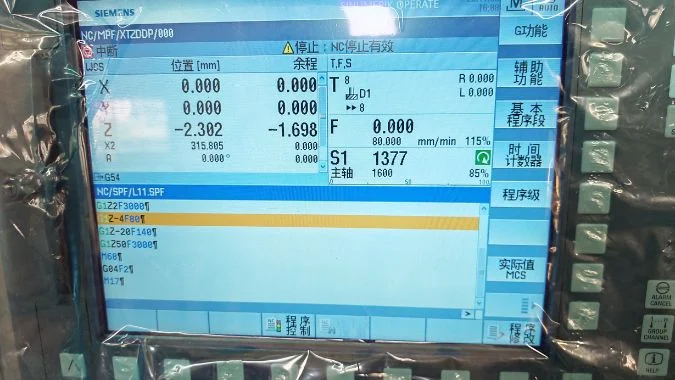
Data tracking records machining time, spindle load, feed rate, alarms, tool use, temperature, and part results. These records support quality traceability, process improvement, maintenance planning, cost control, and faster investigation when a part fails inspection.
What Machining Data Can the CNC System Record?
A CNC system can record basic cycle information, including program numbers, operating time, tool calls, axis movement, spindle speed, feed rate, alarms, and machine status. More advanced systems may also collect spindle load, motor load, temperature, vibration, tool-life values, probe results, and energy use.
The available records depend on the controller, sensors, software options, and factory network. Some machines store data locally. Others send information to a manufacturing execution system, an IoT platform, or production management software10. Part numbers, work orders, operator records, and inspection results can then be linked to the machining history.
How Does Traceability Improve Quality and Maintenance?
Traceability creates a clear record of how a part was produced. If inspection finds an incorrect hole size or position, production staff can compare the program, tool record, machine alarms, and measured results. This information helps separate a programming issue from tool wear, fixture movement, machine drift, or material variation.
Data also supports preventive and predictive maintenance11. Repeated spindle-load increases may show that a tool is becoming dull. Rising temperature or vibration may point to a bearing, lubrication, or alignment problem. Maintenance can then take place before a serious failure stops production.
Accurate cycle records improve costing as well. Managers can compare planned cycle time with actual machine time. They can identify long setup periods, frequent tool changes, and repeated stoppages. This evidence supports better scheduling and process changes.
Data collection alone does not create improvement. Records must be accurate, organized, and reviewed. Clear naming rules, secure storage, calibrated sensors, and defined response limits are required. When these practices are in place, the CNC gantry drilling machine becomes part of a controlled production system rather than only an automatic drilling machine.
Conclusion
CNC gantry drilling machines combine automation, accuracy, process flexibility, higher output, lower labor demand, and traceable data for efficient machining of large and complex workpieces.
-
"Application of AC servo motors in cnc machine", https://www.northservomotor.com/application-of-ac-servo-motors-in-cnc-machine/. Servo motors in CNC systems convert digital position commands into precise rotational motion through closed-loop control, typically driving ball screws or linear motors that translate rotary motion into linear axis movement. Evidence role: mechanism; source type: encyclopedia. Supports: the operating principle of servo-controlled positioning in CNC machine tools. ↩
-
"Heat exchangers – Tube Sheet – Industries", https://tungaloy.com/industries/heat-exchanger_tube-sheet/. Heat exchanger tube sheets, which require hundreds of precisely positioned holes, are commonly manufactured using CNC drilling systems; similar requirements exist for large flanges in pressure vessel and petrochemical applications. Evidence role: case_reference; source type: institution. Supports: typical industrial applications requiring large-format drilling operations. Scope note: This describes common applications but does not constitute an exhaustive list of gantry machine uses ↩
-
"Scale vs encoder feedback. How accurate and how do you …", https://www.practicalmachinist.com/forum/threads/scale-vs-encoder-feedback-how-accurate-and-how-do-you-see-your-backlash.299295/. Fully closed-loop systems measure actual table or tool position using linear scales mounted on the machine axes, compensating for mechanical transmission errors, while semi-closed-loop systems measure motor shaft position and assume perfect mechanical transmission. Evidence role: mechanism; source type: education. Supports: the distinction between fully closed-loop and semi-closed-loop position control in CNC machines. ↩
-
"Ball Screw Definitions – Industrial Solutions Lab – UNC Charlotte", https://isl.charlotte.edu/ball-screw-definitions/. A ball screw is a mechanical linear actuator that converts rotational motion to linear motion with minimal friction, using recirculating ball bearings between a threaded shaft and nut to achieve high efficiency and precision in CNC machine tool positioning systems. Evidence role: definition; source type: encyclopedia. Supports: the function and design principle of ball screws in precision positioning systems. ↩
-
"Backlash (engineering)", https://en.wikipedia.org/wiki/Backlash_(engineering). Backlash refers to the clearance or lost motion between mating mechanical components; in precision machine tools, preloaded ball screws apply axial force to eliminate clearance between balls and screw threads, thereby reducing positioning hysteresis. Evidence role: definition; source type: encyclopedia. Supports: the definition of backlash in mechanical systems and methods for its reduction. ↩
-
"Robust Machine Tool Thermal Error Modeling Through …", http://wumrc.engin.umich.edu/wp-content/uploads/sites/51/2013/08/08JMSEZhuMachinetoolthermalerrorcompensation.pdf. Research on machine tool thermal behavior shows that temperature variations from spindle motors, ambient conditions, and cutting processes cause dimensional changes in machine structures, with thermal drift contributing 40-70% of total positioning error in precision machining. Evidence role: mechanism; source type: research. Supports: how thermal expansion affects positioning accuracy in machine tools during operation. Scope note: The percentage range reflects varying machine designs and operating conditions across different studies ↩
-
"ISO 230 CNC Accuracy Standards: Tests & Acceptance …", https://www.hymsonlaser.com/resources/articles/iso-standards/. Studies of large-format CNC machine tools report positioning accuracies in the range of ±0.01 to ±0.05 mm depending on machine construction, thermal management, and feedback systems. Evidence role: statistic; source type: research. Supports: typical positioning accuracy ranges achievable by industrial CNC gantry machines. Scope note: Actual accuracy varies with specific machine configuration, maintenance state, and operating conditions ↩
-
"Speeds and Feeds", https://web.mae.ufl.edu/designlab/Advanced%20Manufacturing/Speeds%20and%20Feeds/Speeds%20and%20Feeds.htm. Solid carbide and indexable insert drills enable higher cutting speeds than conventional high-speed steel tools due to superior wear resistance and thermal properties, with carbide tools supporting cutting speeds 2-4 times higher in steel machining. Evidence role: general_support; source type: research. Supports: the performance advantages of modern drilling tool technologies. Scope note: Achievable speeds depend on workpiece material, machine rigidity, coolant delivery, and specific tool geometry ↩
-
"How Automation Can Boost CNC Productivity", https://sintoamerica.com/how-automation-can-boost-cnc-productivity/. Manufacturing studies report productivity increases ranging from 2× to 8× when transitioning from manual to CNC machining operations, with labor time reductions of 30-60% depending on part complexity and batch size. Evidence role: statistic; source type: research. Supports: documented productivity improvements from CNC automation in machining operations. Scope note: These ranges reflect diverse manufacturing scenarios; actual improvements depend heavily on specific part geometry, production volume, and baseline process efficiency ↩
-
"ERP and MES Integration: Optimizing Production …", https://excellerant-mfg.com/feeds/blog/mes-erp-integration. Contemporary CNC controllers commonly support industrial communication protocols including OPC UA, MTConnect, and Ethernet-based systems that enable integration with manufacturing execution systems and real-time production monitoring platforms. Evidence role: general_support; source type: institution. Supports: the technical capability of modern CNC systems to exchange data with enterprise manufacturing systems. ↩
-
"What is Predictive Maintenance?", https://www.ibm.com/think/topics/predictive-maintenance. Predictive maintenance uses condition-monitoring data such as vibration, temperature, and performance metrics to forecast equipment failures before they occur, enabling maintenance scheduling based on actual equipment state rather than fixed time intervals. Evidence role: definition; source type: encyclopedia. Supports: the concept and methodology of predictive maintenance in industrial equipment. ↩

Chris Lu
Leveraging over a decade of hands-on experience in the machine tool industry, particularly with CNC machines, I'm here to help. Whether you have questions sparked by this post, need guidance on selecting the right equipment (CNC or conventional), are exploring custom machine solutions, or are ready to discuss a purchase, don't hesitate to CONTACT Me. Let's find the perfect machine tool for your needs.