

How to Choose Between Plunge Grinding and Traverse Grinding on CNC External Grinder?
A short journal can take a plunge cut. A long shaft cannot. The wrong OD method burns time or burns the part. Length, stiffness, and finish set the choice.
Plunge grinding and traverse grinding on a CNC external grinder are chosen by grinding length, workpiece rigidity, and precision. Plunge is faster on short, stiff diameters when the wheel is wider than the land. Traverse is the safer method on long shafts, because force and heat stay lower.
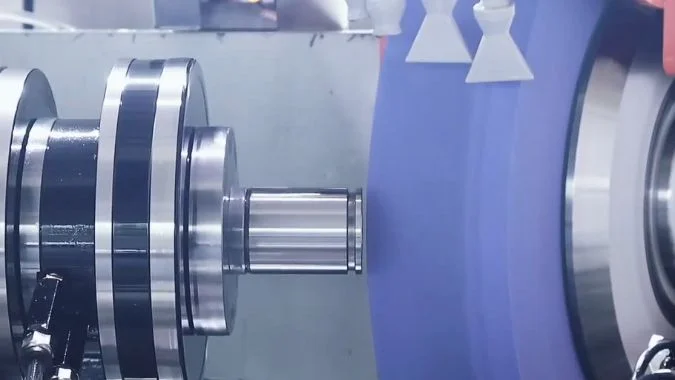
The first trap is treating any OD grind as a traverse pass. A wide wheel on a short journal can finish the land in one radial cut.1 A thin wheel on a long shaft has to walk the length. Mixing those motions wastes time, or it burns the surface. That split is plunge versus traverse grinding.
What Is the Difference Between Plunge Grinding and Traverse Grinding on an OD Grinder?
Shops mix the two OD methods. The wheel then wastes strokes on a short land, or it loads a long shaft in one plunge.
Plunge grinding and traverse grinding differ in axial motion. Plunge uses a wheel wider than the land, and the part does not move along its axis. Traverse uses a narrower wheel, and the part or the wheel walks the length in many light strokes.
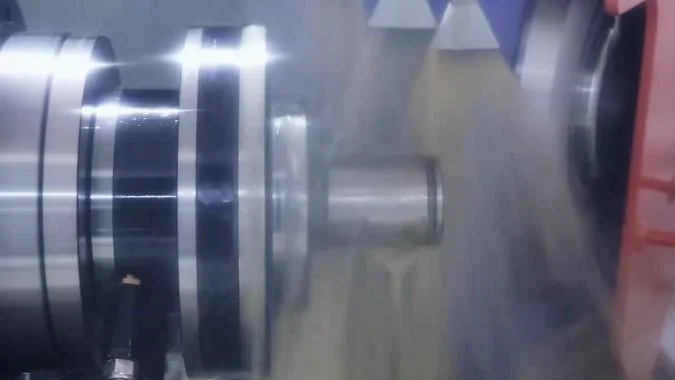
How plunge grinding moves
Plunge grinding uses a wheel that is wider than the ground land. The workpiece rotates. The workpiece does not travel along its axis. The wheel feeds straight in on the radius. The full width of the wheel cuts at once. A dressed form can also go in on that same radial path. Short steps, journals next to a shoulder, and profiled OD lands fit this motion. A CNC external cylindrical grinding machine can run this cycle with the infeed rate set in the program.
How traverse grinding moves
Traverse grinding uses a wheel that is narrower than the ground length. The workpiece rotates. The table or the wheel then moves back and forth along the axis. Each pass cuts a small band. Many strokes cover the full OD. Long shafts, slender bars, and tight-roundness jobs favor this motion.
The core split
Plunge grinding is faster. Traverse grinding holds size and finish more easily.2 That is the core split. A shop does not have to pick only one for the whole job. A composite cycle can plunge-rough in segments, then leave a finish stock, then traverse-finish the OD.3 The plunge step removes bulk stock. The traverse step cleans the diameter and the roundness.
| Item | Plunge grinding | Traverse grinding |
|---|---|---|
| Axial motion | None on the land | Reciprocating along the axis |
| Wheel width vs land | Wheel wider than the land | Wheel narrower than the length |
| Contact | Full wheel width at once | Small band each stroke |
| Strength | Cycle time | Roundness, roughness, heat control |
| Weakness | Heat and force in one band | More strokes, longer cycle |
| Typical parts | Short steps, journals, formed OD | Long shafts, slender bars |
When Does a Wide Wheel Make Plunge Grinding Faster Than Traversing?
A wide wheel looks fast on every OD. On a long land it still cannot cover the cut, so the cycle stretches and heat stacks.
A wide wheel makes plunge grinding faster than traversing when the wheel is wider than the ground land. The part does not need axial travel. The wheel then forms the OD in one radial cut. Long lands, slender shafts, and thin walls still need traverse grinding.
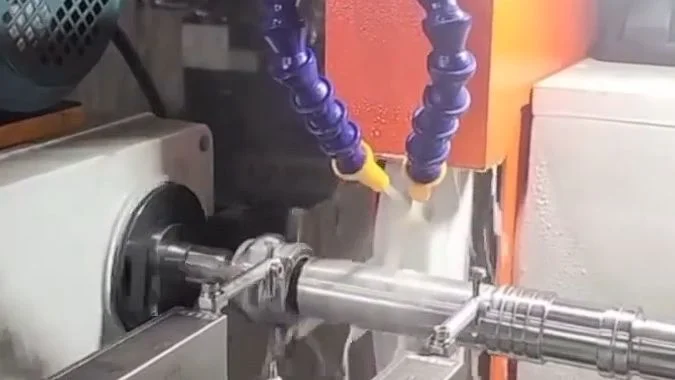
The width rule
A wide wheel makes plunge grinding faster only when the wheel is wider than the ground land. The wheel then covers the surface in one radial feed. The workpiece does not need to move along its axis. Axial stroking drops out of the cycle, so the clock time falls. The rule flips once the land is longer than the wheel. The wheel cannot cover the OD. Segmented plunges then try to stitch the length. Blend lines show up, and the cycle is no longer short. Traverse grinding is the honest method on that longer land.
Batch work and formed diameters
The time gain is large on rigid, short cylinders in batch work. Spline shafts, motor shafts, and drive shafts often have short journals that fit a wide wheel. Repeat lots stack the saving, because every piece skips the traverse strokes. Form grinding is the other gain. The wheel is dressed to the profile. One plunge then forms the shape.4 A traverse pass would have to follow that form in many strokes.
When traverse still wins
Slender shafts, thin-wall parts, and very tight roundness jobs still need traverse grinding.5 Plunge force is high. The part can bend, burn, or go out of round. Traverse grinding is slower. It is also more stable. Wide-wheel plunge also needs a stronger coolant stream, because the contact patch is large. Wheel hardness must stay even across the width.6 A wide wheel on a long spindle overhang will print hardness variation into the diameter.
| Condition | Faster method | Reason |
|---|---|---|
| Wheel wider than the land | Plunge | One radial form cut, no axial walk |
| Land longer than the wheel | Traverse | Wheel cannot cover the OD in one plunge |
| Batch short journals, good stiffness | Plunge | Cycle time drops on repeat work |
| Formed OD from a dressed wheel | Plunge | Profile is cut in one infeed |
| Slender, thin-wall, or very tight finish | Traverse | Lower force and better heat spread |
How Should Work Speed and Wheel Infeed Differ Between the Two Methods?
The same rpm and the same infeed do not serve both methods. Heat then piles up on a plunge, or a traverse pass polishes instead of cutting.
Work speed can sit a little higher on plunge grinding, and wheel infeed is larger and continuous. Traverse grinding uses a lower work speed. Infeed is smaller and comes in steps. Plunge rough infeed often sits at 0.1–5 mm/min. Traverse depth is often 0.002–0.02 mm per stroke.
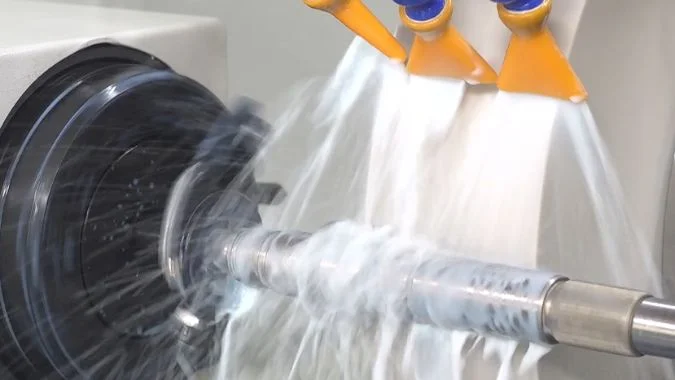
Workpiece speed
Plunge grinding puts a wide contact patch on the diameter. Grinding force is high. Heat is concentrated.7 Work speed must not run too high, because burns then get worse. It can still sit a little above the traverse speed on the same diameter. Traverse grinding uses a narrower wheel. The contact patch is small. Force is low. Heat leaves the zone more easily. Work speed is usually lower, so the surface stays even along the length.
Wheel infeed
Plunge grinding feeds the wheel on the radius. The infeed can be continuous, or it can be a timed step. Roughing can use a high radial rate, often 0.1–5 mm/min. Finishing then drops that rate, because a fast finish plunge burns the band. Traverse grinding feeds in small radial steps. Each stroke takes a light cut, often 0.002–0.02 mm. The allowance comes off across many reciprocating passes, not in one radial dive.
How those numbers guide the choice
Short, stiff parts in large lots favor plunge settings. The higher infeed and the slightly higher work speed cut cycle time. Long work, slender shafts, and high finish work favor traverse settings. The lower work speed and the tiny infeed protect roundness and roughness. The machine can store both as CNC cycles. The part geometry still decides which cycle is safe.
| Setting | Plunge grinding | Traverse grinding |
|---|---|---|
| Work speed | A little higher than traverse, but still capped to limit burns | Lower, to hold surface quality along the length |
| Infeed type | Continuous or stepped radial infeed | Small radial step each stroke |
| Rough infeed | Often 0.1–5 mm/min | Often 0.002–0.02 mm per stroke |
| Finish infeed | Reduced to protect the band | Still light, across many strokes |
| Best fit | Short, stiff, batch OD work | Long, slender, high-finish OD work |
Why Can Plunge Grinding Leave a Deeper Heat Band Than a Light Traverse Pass?
A plunge can look clean at the machine. The part then shows a darker band after the next process, and the journal has to be reworked.
Plunge grinding can leave a deeper heat band because the contact arc is long and the infeed stays on one spot. Heat builds in that band and soaks below the surface. A light traverse pass spreads the same heat along the stroke, so the damaged layer stays shallower.
Worse heat escape
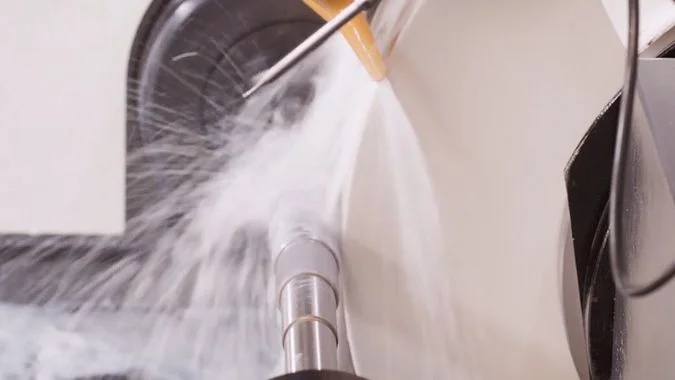
Plunge grinding has a long contact arc between the wheel and the workpiece. Grinding heat cannot leave that arc easily. It piles up on the surface. Coolant still helps, but the patch is wide, so fluid cannot reach every grit.8 Traverse grinding uses a wheel that is narrower than the workpiece length. The grinding zone keeps moving. Heat has a path out, so the surface stays cooler.
Heat stays in one band
Plunge grinding feeds on the radius without an axial walk. The full wheel width cuts in the same band the whole time. Heat keeps landing on that one ring. Continuous radial infeed does not give the surface a rest. Traverse grinding takes a small depth of cut. The wheel then moves along the axis. Heat is dropped at new positions along the stroke. A traverse stroke leaves the grain, then comes back on a cooler ring. A hot spot is harder to form.
Why the damaged layer is deeper
Heat that cannot escape is driven below the surface. The damaged layer then sits deeper. Even a light traverse stroke spreads the load, so less heat soaks in. Plunge grinding parks heat on one band. Traverse grinding spreads that heat along the stroke and carries it off. That is why a plunge is more likely to leave a deeper burn layer than a light traverse pass.
| Heat factor | Plunge grinding | Light traverse pass |
|---|---|---|
| Contact arc | Long, full wheel width | Short, moving band |
| Infeed | Stays on one ring | Walks along the axis |
| Heat path | Parks on one spot | Spreads and is carried off |
| Coolant access | Harder in a wide patch | Easier on a narrow moving cut |
| Result | Deeper heat-affected layer | Shallower heat-affected layer |
Conclusion
Choose plunge on short, stiff lands when the wheel covers the cut. Choose traverse on long or slender work. Heat and infeed must follow that choice.
-
"How to achieve accurate grinding results and avoid taper …", https://www.facebook.com/groups/769782850345135/posts/1456732908316789/. Grinding engineering literature confirms that when wheel width exceeds the ground length, plunge grinding can form the surface in a single radial pass, eliminating axial traverse motion. Evidence role: mechanism; source type: research. Supports: that a grinding wheel wider than the workpiece land can complete the surface in one radial infeed. Scope note: The source addresses the geometric principle but may not specify exact efficiency gains across all material types. ↩
-
"Optimization of parameters in cylindrical and surface grinding …", https://pmc.ncbi.nlm.nih.gov/articles/PMC5990843/. Grinding process research indicates that plunge grinding reduces cycle time by eliminating axial motion, while traverse grinding achieves superior roundness and surface finish through distributed heat input and incremental stock removal. Evidence role: general_support; source type: research. Supports: the relative advantages of plunge versus traverse grinding in terms of speed and precision. Scope note: Performance advantages depend on workpiece geometry, material properties, and specific grinding conditions. ↩
-
"Cylindrical grinding: Plunging vs traverse : r/Machinists", https://www.reddit.com/r/Machinists/comments/zqgbpu/cylindrical_grinding_plunging_vs_traverse/. CNC grinding process literature describes composite cycles that use plunge grinding for rapid stock removal followed by traverse finishing to achieve final dimensional accuracy and surface quality. Evidence role: general_support; source type: research. Supports: that combining plunge roughing with traverse finishing can optimize grinding operations. Scope note: Implementation requires appropriate CNC programming capabilities and may not be beneficial for all workpiece geometries. ↩
-
"Grinding Wheel Texture and Diamond Roll Plunge Dressing …", https://digital.wpi.edu/downloads/t148fm85p. Grinding engineering literature describes form grinding as a plunge method where the wheel is dressed to a specific contour, allowing complex profiles to be generated in a single radial feed without axial motion. Evidence role: mechanism; source type: research. Supports: that form grinding uses a profiled wheel to generate complex shapes in one radial infeed. Scope note: Form accuracy depends on wheel dressing precision, wheel wear characteristics, and grinding forces that may cause deflection. ↩
-
"(PDF) Closed Loop Control of Milling Tool Deflection", https://www.academia.edu/24783195/Closed_Loop_Control_of_Milling_Tool_Deflection. Precision grinding literature recommends traverse grinding for slender or thin-walled workpieces because distributed force application minimizes deflection, and incremental stock removal with multiple passes improves roundness control. Evidence role: general_support; source type: research. Supports: that traverse grinding is preferred for low-rigidity workpieces and tight roundness specifications. Scope note: The rigidity threshold for method selection depends on specific workpiece geometry, material, and tolerance requirements. ↩
-
"Evaluation of grinding wheel performance", https://www.sciencedirect.com/science/article/abs/pii/0043164880901532. Grinding wheel engineering literature emphasizes that hardness variation across the wheel face in plunge grinding causes uneven wear rates and cutting forces, resulting in surface irregularities and dimensional errors on the workpiece. Evidence role: mechanism; source type: research. Supports: that wheel hardness uniformity is critical for plunge grinding quality. Scope note: The acceptable hardness variation depends on tolerance requirements and may be specified differently by wheel manufacturers. ↩
-
"(PDF) Thermal Analysis of Grinding", https://www.academia.edu/100104725/Thermal_Analysis_of_Grinding. Grinding mechanics studies show that plunge grinding creates a contact zone equal to the full wheel width, concentrating grinding forces and thermal energy in a narrow axial band on the workpiece. Evidence role: mechanism; source type: research. Supports: that plunge grinding generates high forces and concentrated heat due to wide wheel-workpiece contact. Scope note: The magnitude of force and heat concentration varies with wheel specification, infeed rate, and coolant effectiveness. ↩
-
"The coolant penetration in grinding with a segmented …", https://www.academia.edu/109714992/The_coolant_penetration_in_grinding_with_a_segmented_wheel_Part_2_Quantitative_analysis. Grinding fluid research indicates that as contact zone width increases, coolant penetration to the wheel-workpiece interface becomes more difficult due to hydrodynamic barriers and air entrainment, reducing cooling effectiveness. Evidence role: mechanism; source type: research. Supports: that wide contact zones in plunge grinding impede coolant access to the grinding interface. Scope note: Coolant delivery method, pressure, and fluid properties significantly affect penetration capability in wide contact zones. ↩

Chris Lu
Leveraging over a decade of hands-on experience in the machine tool industry, particularly with CNC machines, I'm here to help. Whether you have questions sparked by this post, need guidance on selecting the right equipment (CNC or conventional), are exploring custom machine solutions, or are ready to discuss a purchase, don't hesitate to CONTACT Me. Let's find the perfect machine tool for your needs.