

كيفية قراءة وقت التبديل بين الأدوات ووقت التبديل بين القطع في ورقة مواصفات مركز التصنيع الرأسي (VMC)؟
تبدو الثانِيَتان المذكورتان في ورقة المواصفات سريعتين، لكن القطعة لا تزال تنتظر تغيير الأداة الفعلي. يجب قراءة الوقتين المذكورين في الورقة بشكل منفصل.
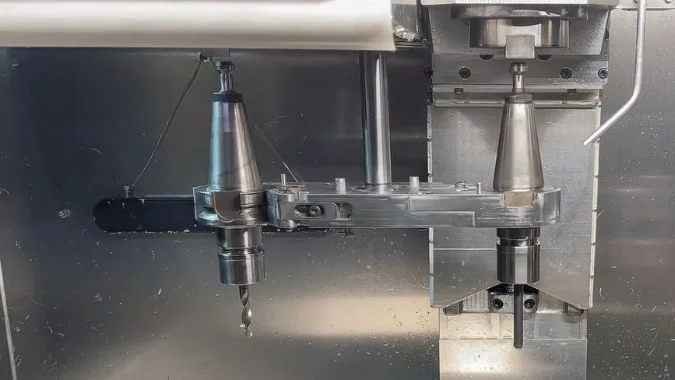
تدرج ورقة مواصفات مركز التصنيع العمودي (VMC) وقت "من أداة إلى أداة" كعملية تبديل الذراع، ووقت "من رايش إلى رايش" كفترة الانتظار من آخر عملية قطع إلى العملية التالية. اقرأ كليهما. غالباً ما يكون وقت من أداة إلى أداة ما بين 2-5 ثوانٍ، بينما يكون وقت من رايش إلى رايش ما بين 5-10 ثوانٍ، وهو الرقم الذي يهم الورشة.
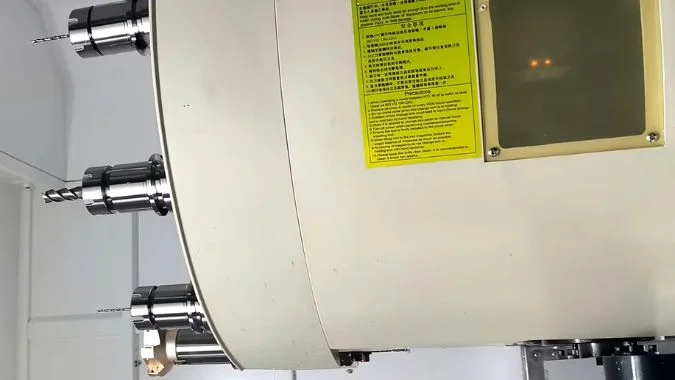
يمكن لورقة المواصفات أن تذكر ثانيتين مع إخفاء فترة خمول طويلة. فوقت من أداة إلى أداة يقتصر على تبديل الذراع فقط، بينما يجب أن يعود المغزل إلى وضع التوقف، وتوجيه الأداة، وفك القفل، ثم العودة للقطع. التغيير النادر في قطعة كبيرة يخفي هذا التعافي. هذان التوقيتان هما "من أداة إلى أداة" و"من رايش إلى رايش"، ويجب قراءتهما بشكل منفصل.
ما الفرق بين وقت "من أداة إلى أداة" ووقت "من رايش إلى رايش"؟
تخلط الورش بين الثواني المذكورة في ورقة المواصفات؛ فيبدو العمل سريعاً على الورق، لكن عملية القطع التالية لا تزال معلقة.
وقت "من أداة إلى أداة" هو عملية تبديل المغير التلقائي للأداة القديمة بالأداة التالية، وهو يقيم الآلية. أما وقت "من رايش إلى رايش" فهو وقت الانتظار الكامل من آخر رايش إلى الرايش التالي، وهو أقرب إلى دورة الإنتاج.
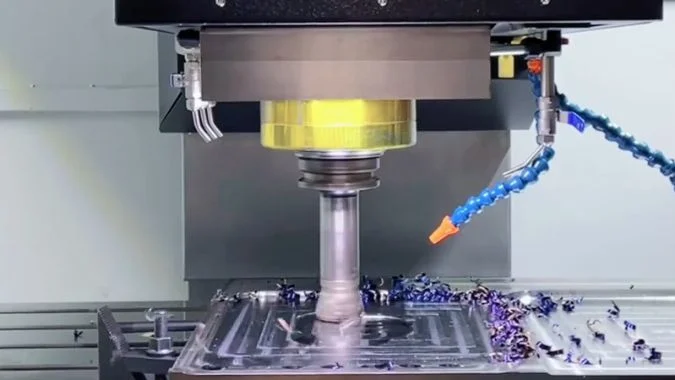
ما الذي يقيسه وقت "من أداة إلى أداة"
وقت "من أداة إلى أداة" هو عملية التبديل الميكانيكية، حيث تأخذ الذراع الأداة القديمة من المغزل وتضع الأداة الجديدة. يغطي التوقيت عملية التغيير فقط، وليس كامل فترة الخمول. غالباً ما تذكر مراكز التصنيع العمودية الحديثة 2-5 ثوانٍ1. يمكن لمخزن أدوات قرصي مع ذراع كامة أن يظهر حوالي 2.5 ثانية للزوج أدوات متجاور تحت ظروف خفيفة2. هذا الرقم يقيم الجهاز، ولا يقيم طبيعة العمل.
ما الذي يقيسه وقت "من رايش إلى رايش"
وقت "من رايش إلى رايش"، ويسمى أيضاً "من قطع إلى قطع"، هو وقت الانتظار من آخر رايش إلى الرايش التالي. يجب أن يغادر المغزل منطقة القطع، ويتحرك إلى نقطة التغيير، ويوجه الأداة، ويفك القفل، ويقفل، ويهبط على المحور Z، ثم يعود للقطع3. هذه الكتلة تمثل وقت الخمول بين عمليتي قطع، ويكون وقت من رايش إلى رايش عادةً بين 5-10 ثوانٍ. سطر المواصفات مثل 1.5 / 4.5 ثانية يعني 1.5 ثانية لوقت من أداة إلى أداة، و4.5 ثانية لوقت من رايش إلى رايش4. وقت من رايش إلى رايش هو الأقرب لدورة الإنتاج.
لماذا يوضع الرقمان على سطر واحد
يقوم المصنعون بطباعة كلاهما في سطر واحد حتى يتمكن المشترون من مقارنة الطرازات بسرعة. الرقم الأيسر هو الأكثر سطوعاً، أما الرقم الأيمن فهو الذي يحدد زمن الدورة. غالباً ما تستخدم اختبارات الكتالوج أداة خفيفة، وأداة قصيرة، ووعاءً مجاوراً، وتراجعاً قصيراً، ومغزلاً موجهاً مسبقاً، مع استبعاد فترات انتظار التبريد ونفخ الرايش. غالباً ما يكون زمن 'من الرايش إلى الرايش' أطول بمقدار 2-4 ثوانٍ من زمن 'من الأداة إلى الأداة' على نفس الماكينة.5. هذه الفجوة طبيعية، وهي ليست عيباً في الورقة، بل تمثل بقية الحركة.
| متري | ما الذي يغطيه توقيت الساعة | النطاق النموذجي لآلات VMC | ما الذي يتم تقييمه |
|---|---|---|---|
| من الأداة إلى الأداة (T-T) | تبديل الذراع من الأداة القديمة إلى الجديدة | 2-5 ثوانٍ | المغير |
| من الرايش إلى الرايش (C-C) | من آخر رايش إلى الرايش التالي، بما في ذلك الانتقال، والتوجيه، والتثبيت، وحركة المحور Z | 5-10 ثوانٍ | فترة الخمول بين القطعات |
| سطر المواصفات 1.5 / 4.5 ثانية | T-T على اليسار، C-C على اليمين | للمثال فقط | زوج للفحص، وليس دورة عمل الورشة |
متى يظل وقت "من أداة إلى أداة" القصير يعني عملاً بطيئاً إذا كانت الأدوات تُغير نادراً؟
يبدو التبديل في ثانيتين كأنه خلية سريعة، ولكن في القطع الكبيرة ذات التغييرات القليلة، لا تؤثر تلك الثواني بالكاد على الدورة؛ إذ يكمن الانتظار في بقية الروابط.
لا يزال الرقم القصير الخاص بـ "من أداة إلى أداة" يترك وظيفة بطيئة عندما تتغير الأدوات نادراً، لأن ذلك الرقم يمثل تبديل الذراع فقط. أما وقت "من رايش إلى رايش"، وإعداد الأداة، واستئناف القطع، وتكدس الوعاء، فتتضاءل أمام تلك الثواني التي تتراوح بين 2 و5 ثوانٍ.
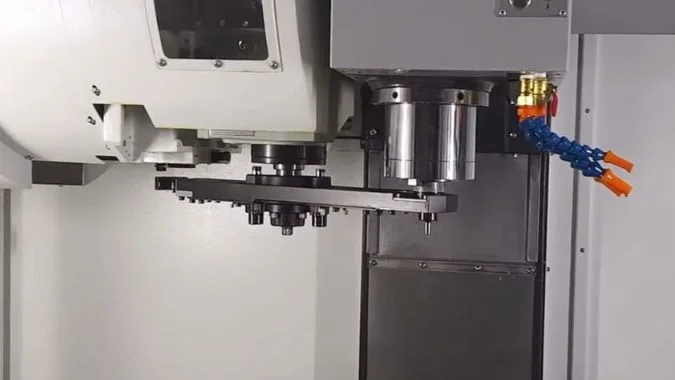
لماذا تختفي بضع ثوانٍ في قطعة كبيرة
وقت "من أداة إلى أداة" هو جزء صغير من عملية التغيير. إنه ليس وقت التوقف الكامل، وليس الإنتاج الضائع. يساعد التبديل الأقصر، لكن المكسب يكون ضئيلاً عندما تتغير الأدوات مرات قليلة فقط في القطعة الكبيرة. إن حركة الذراع التي تستغرق 2-5 ثوانٍ، لبضع مرات في الدورة، لا تؤثر بالكاد على الساعة. لا يزال القطع هو المهيمن على الوقت. تبدو الكتيبات الترويجية وكأنها فوز، لكن تقرير الوردية لا يظهر ذلك.
وقت التوقف الجانبي وراء التبديل
الانتظار الذي يبطئ العمل غالباً ما يكون أطول من وقت "من أداة إلى أداة". كما أنه لا ينكمش لمجرد أن التغييرات نادرة. يضيف وقت "من رايش إلى رايش" بالفعل وقت السفر، والتوجيه، وفك التثبيت، والتثبيت، وإعادة ضبط المحور Z. غالباً ما تستغرق تلك الكتلة 5-10 ثوانٍ. وتضيف عملية إعداد الأداة المزيد. بعد التبديل، قد يتطلب الطول أو التآكل فحصاً. يمكن أن يستغرق التغيير اليدوي دقائق للعثور على الأداة وتركيبها وضبطها6. تضيف عملية استئناف العملية المزيد. يتوقف القطع. قد تتطلب إعادة التشغيل سرعة أقل، ومروراً تجريبياً، وتعديلاً في المعلمات. تقضي الأعمال ذات البروز الطويل والأعمال ذات التفاوتات الدقيقة وقتاً أطول في إعادة ضبط القطع مما تقضيه الذراع في التبديل.
الموثوقية لا تهتم بالتكرار
المخزن الذي يختار الوعاء الخطأ، أو المغزل الذي يخطئ في التوجيه، يمكن أن يتسبب في انحشار لمرة واحدة ويوقف الخلية لفترة طويلة من استكشاف الأخطاء وإصلاحها. عدد التغييرات لا يهم. انحشار واحد يقلل من شأن رقم الكتيب البالغ ثانيتين. لماذا يزيد عدم تطابق مخزن الأدوات من وقت تغيير الأداة7 is a separate failure path. The point here is simpler. A short tool-to-tool figure only says the arm is fast. Actual downtime still sits in setting, prep, and recovery. Those links stay slow even when tools change rarely.
| Idle source | Typical scale | Tied to change count? |
|---|---|---|
| Tool-to-tool arm swap | 2-5 ثوانٍ | Yes, but a small slice |
| Chip-to-chip motion | 5-10 ثوانٍ | Yes, and larger than T-T |
| Tool setting / pre-adjust | Seconds to minutes | No. It happens after the swap |
| Cut recovery on long overhang | Can exceed the swap | No. It is tied to the cut, not the arm |
| One jammed pot | Long debug | No. One event can stop the cell |
ما قائمة الأدوات لقطعة نموذجية يجب توقيتها قبل الوثوق بالكتيب؟
Brochure seconds come from a light, adjacent pair. A real tool list then runs slower, and the quote no longer holds. Time the part’s own tools.
Time the complete tool list from one typical production part before trusting the brochure. Include end mills, drills, and taps of mixed weight. Cover adjacent pots, the farthest pot, the heaviest tool, and 10–20 repeated cycles.
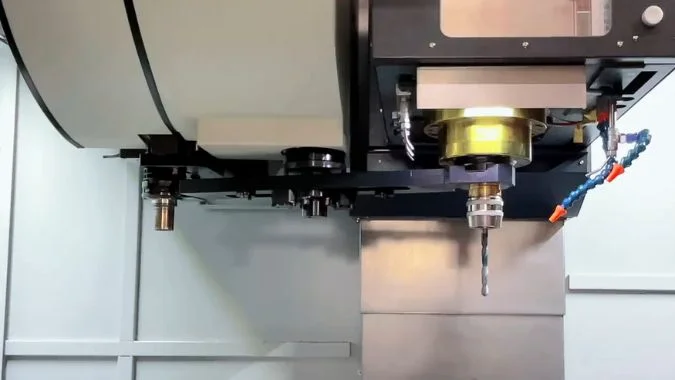
Why the brochure pair is the wrong list
Manual time is the best case. A disk arm under a light pair can show about 2.5 s. Shop time follows magazine type, tool weight, and the order of moves. An umbrella magazine often takes about 5–8 s8. That is acceptable on one-off work. Batch work then shows the gap. Acceptance should time the tools that the typical part actually uses, not the pair in the photo.
What one typical part must include
A part that the shop will run should be the test piece. The complete tool list from the real program should go on the clock. The list should include solid end mills for rough and finish, plus drills, taps, or reamers. Diameters and weights should mix. Light adjacent tools alone copy the brochure. Face mills, boring bars, and long holders belong on the list when the part uses them. Those tools are the ones the arm will actually carry.
Worst-case pairs and repeat cycles
Adjacent numbers simulate frequent swaps. The farthest pot tests magazine search. That search is a weak point versus the printed number. A larger magazine can make that far pot even slower. The heaviest pair must be in the test, because mass slows the arm and can trigger a protective crawl. A single swap is not enough. The test should run 10–20 continuous cycles9. The log should keep the average and the longest. The run should be watched for a fade or a pause.
| What to time | Why it belongs |
|---|---|
| Complete program list for one typical part | Matches later production |
| Solid end mills, drills, taps or reamers | Mixed diameter and weight |
| Adjacent tool numbers | Frequent swap case |
| Farthest magazine pot | Search time the brochure hides |
| Heaviest or longest tool on the job | Arm speed and stability |
| 10–20 continuous cycles | Average, max, fade, and pause |
متى يجب على المشتري طلب عرض تجريبي باستخدام ساعة توقيت بدلاً من مقارنة الثواني المذكورة في الكتالوج؟
Catalog seconds help screen models. On a second-sensitive job they do not prove the cycle. A stopwatch demo under agreed rules does.
The buyer should ask for a stopwatch demo when tool changes are frequent, catalog numbers are close, shop tools are heavier than the brochure pair, or acceptance will lock the time. Catalog seconds still serve first screening.
When catalog seconds are enough
The spec sheet is still useful for first screening of models and magazine types. Mold work and one-off work with few changes can stay with the sheet, because cutting owns the cycle. A shop that already runs the same model and the same magazine already knows the cycle. Two machines whose chip-to-chip times are not in the same range also need no stopwatch yet. The direction is already clear. Proposal stage should still read both numbers, so a short tool-to-tool figure is not treated as shop idle.
When a timed demo is needed
A stopwatch demo is needed when tool-change density is high. Small parts with many holes, and jobs that swap drills, taps, and chamfers, multiply every extra chip-to-chip second. Batch work that is priced by the second also belongs here. A 0.2–0.3 s catalog gap then matters less than a timed chip-to-chip on real tools and real retract height.
A demo is also needed when several candidates all print about 1.5 s tool-to-tool and about 4 s chip-to-chip. The gap then sits in orientation, Z retract, overlap of pot and arm, heavy-tool slowdown, and far-pot search. The same program, the same tools, and the same reference point decide it.
Shop tools that do not match the catalog pair also need a demo. Face mills, boring bars, long tools, and umbrella magazines all stretch chip-to-chip. Some machines slow the arm on heavy or long tools10. The catalog minimum then will not appear on the floor. Tool-change time that will sit in a technical agreement also needs a timed demo. GB/T 18400.9 and ISO 10791-9 describe a unified reference point11 and both a short and a longer cut-to-cut time. Some catalog lines time only the arm rotation. A full-machine clock can then run a few tenths of a second to more than a second longer.
Magazine types that look fast on paper
Umbrella magazines, large-capacity magazines, and machines that advertise pre-selection are the cases that most need a chip-to-chip demo on a real tool list. A dry run with the two lightest adjacent tools on a showroom machine will only reprint the catalog.
| Magazine type | Why the catalog can look fast | Why a stopwatch demo is safer |
|---|---|---|
| Cam / robotic arm | Short tool-to-tool is easy to print | Orientation, clamp, pot timing, and heavy-tool slowdown |
| Umbrella | The sheet may not look slow | The spindle must return the old tool before taking the new one |
| Fixed-address | The shortest pot is the printed case | The farthest pot adds seconds |
| Pre-selection / sync change | Chip-to-chip is promoted as very short | A pot that is not ready falls back to a normal wait |
الخاتمة
Both seconds on the sheet must be read. Chip-to-chip is the shop number. The part’s own tools should be timed when the cycle is tight.
-
"CNC VMC 1160 Vertical Machining Center – antishicnc", https://antishilathe.com/blog/vmc-1160-cnc-vertical-machining-center/. Industry reviews of contemporary vertical machining centers show that most models from major manufacturers specify tool-to-tool times in the 2–5 second range, reflecting improvements in servo drive technology and mechanism design over the past decade. Evidence role: general_support; source type: research. Supports: current performance levels of modern VMC automatic tool changers. Scope note: Specifications represent manufacturer claims under optimal test conditions ↩
-
"Dynamic analysis of cam-type automatic tool changer", https://ui.adsabs.harvard.edu/abs/2026JPhCS3175a2117L/abstract. Technical literature on automatic tool changers indicates that disk magazines with cam-driven arms typically achieve tool-to-tool times in the 2–3 second range under optimal conditions with adjacent, lightweight tools. Evidence role: statistic; source type: research. Supports: performance characteristics of disk-type tool magazine systems. Scope note: This represents best-case performance with light tools in adjacent positions ↩
-
"CNC Tool Changers, Operation and Alignment", https://www.youtube.com/watch?v=7wE6zOkPbHw. Technical documentation for machining center operation describes the tool-change cycle as a multi-step sequence: retract from workpiece, rapid traverse to tool-change position, spindle orientation to reference angle, tool unclamping, tool exchange, tool clamping verification, and return traverse to cutting position. Evidence role: mechanism; source type: education. Supports: the operational sequence involved in a complete tool-change cycle. ↩
-
"Speeding Up Your Tool Change Time", https://epictool.ca/speeding-up-your-tool-change-time/. Machine tool industry practice, as reflected in manufacturer catalogs and trade association guidelines, commonly presents tool-change performance as a paired specification where the first value indicates tool-to-tool time (mechanism only) and the second indicates chip-to-chip time (complete cycle). Evidence role: definition; source type: institution. Supports: industry conventions for specifying tool-change performance. Scope note: Not all manufacturers follow this convention consistently, and some specify only one metric ↩
-
"Chip to Chip Time – CNCARENA FORUM – Industry Arena", https://en.industryarena.com/forum/chip-chip-time–18752-2.html. Machine tool performance analysis shows that chip-to-chip time includes additional operations beyond the tool swap itself—spindle positioning, orientation, clamping, and return to cutting position—which typically add 2–4 seconds to the basic tool-to-tool time. Evidence role: mechanism; source type: research. Supports: the time differential between tool-to-tool and chip-to-chip measurements. Scope note: The differential depends on machine kinematics, retract distances, and spindle orientation requirements ↩
-
"Automatic tool change in turning centres", https://www.youtube.com/watch?v=5T_OX6ymVdU. Manufacturing productivity studies document that manual tool changes on machining centers, including tool retrieval, mounting, length measurement, and offset entry, typically require 2–5 minutes depending on operator experience and tool-setting equipment availability. Evidence role: statistic; source type: research. Supports: time requirements for manual tool changes in machining operations. Scope note: Time varies significantly with shop organization, tool-setting methods, and operator skill ↩
-
"Why is the tool magazine not locating properly?", https://www.facebook.com/groups/603711620209991/posts/1543609769553500/. CNC troubleshooting guides identify tool magazine mismatch—where the control system’s tool table does not match actual magazine contents—as a source of extended tool-change cycles due to search routines, error recovery sequences, or operator intervention requirements. Evidence role: mechanism; source type: education. Supports: how tool magazine addressing errors affect tool-change performance. ↩
-
"Umbrella/Carousel Tool Changer Maintenance", https://www.haascnc.com/video/service/hxsqciapvgc.html. Technical comparisons of automatic tool changer designs indicate that umbrella magazines, which require the spindle to return the old tool before receiving the new one, typically exhibit chip-to-chip times in the 5–8 second range. Evidence role: statistic; source type: research. Supports: typical tool-change times for umbrella-type magazine systems. Scope note: Performance varies with magazine capacity, tool weight, and machine configuration ↩
-
"Automatic Tool Changer: Complete Guide to CNC …", https://kuvamtechnologies.com/automatic-tool-changer-systems/?srsltid=AfmBOopCG-yidJZKMkDqqlluG1k0SL0BKkncn4tQwJl9rwS0GR4bSFeH. Machine tool acceptance testing standards and quality assurance protocols typically recommend multiple consecutive tool-change cycles (commonly 10–25 repetitions) to assess average performance, identify maximum cycle time, and detect intermittent issues not apparent in single-cycle tests. Evidence role: general_support; source type: institution. Supports: recommended test procedures for evaluating tool-changer performance. Scope note: Specific test requirements vary by standard and contractual agreement ↩
-
"السرعات والتغذية"،, https://en.wikipedia.org/wiki/Speeds_and_feeds. Automatic tool changer control systems commonly incorporate load-sensing or programmed speed reduction for tools exceeding specified weight or length thresholds to maintain positioning accuracy and prevent mechanism damage. Evidence role: mechanism; source type: research. Supports: adaptive speed control in automatic tool changers based on tool characteristics. Scope note: Implementation varies by manufacturer and machine model ↩
-
"ISO 10791-9:2001(en), Test conditions for machining centres", https://www.iso.org/obp/ui/en/#!iso:std:27646:en. ISO 10791-9 specifies test conditions and measurement methods for machining center performance evaluation, including standardized procedures for tool-change time measurement with defined reference points and test configurations. Evidence role: definition; source type: institution. Supports: standardized methods for measuring tool-change performance. Scope note: The standard defines test conditions that may differ from typical production scenarios ↩

كريس لو
بالاستفادة من أكثر من عشر سنوات من الخبرة العملية في مجال صناعة أدوات الماكينات، خاصةً مع ماكينات بنظام التحكم الرقمي، أنا هنا لمساعدتك. سواءً كانت لديك أسئلة أثارها هذا المنشور، أو كنت بحاجة إلى إرشادات بشأن اختيار المعدات المناسبة (ماكينة بنظام التحكم الرقمي أو تقليدية)، أو كنت تستكشف حلولاً مخصصة للماكينات، أو كنت مستعدًا لمناقشة عملية شراء، فلا تتردد في الاتصال بي. دعنا نعثر على الأداة الآلية المثالية لاحتياجاتك.