

Why Does Tool Magazine Mismatch Increase Tool Change Time?
A fast spindle cannot protect cycle time when a mismatched tool magazine adds slow searches, long movements, vibration limits, and repeated safety waits.
Tool magazine mismatch increases tool change time because excessive capacity, poor drive matching, long search paths, and conservative interlocks extend non-cutting time. A suitable magazine uses pre-selection, shortest-path indexing, matched inertia, and overlapping safety actions to support the spindle’s actual production cycle.

A quoted tool-to-tool time can appear impressive under empty-load testing. Actual production may still suffer from slow spindle positioning, distant tools, full-load inertia, and stacked confirmation delays. Each source of delay deserves a closer look.
How Do System Parameters Increase Tool Change Time?
A machine may have fast hardware, yet conservative parameters can force long retractions, slow magazine indexing, and unnecessary waiting during every tool change.
System parameters increase tool change time when they require distant change positions, excessive safety heights, long spindle orientation delays, or serial magazine movement. Better settings reduce unnecessary travel and allow tool pre-selection without removing essential protection.
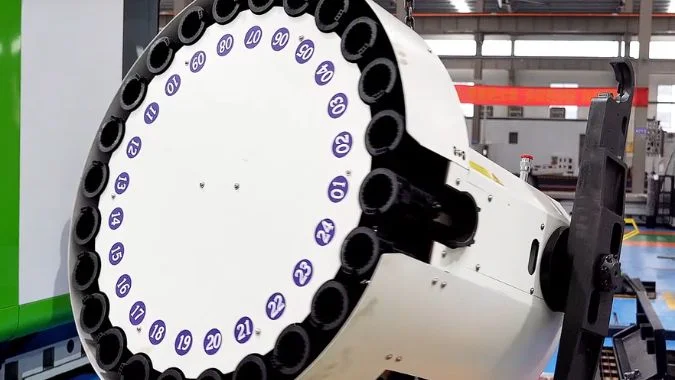
Fixed Tool Change Positions
A fixed tool change point can create a long path before the automatic tool changer starts. For example, a system may require the Z-axis to return to its mechanical origin. The spindle must retract, reach the target coordinate, stop, and complete orientation. A tool change near the final cutting position would require much less movement, but the parameter prevents that option.
An excessive safety plane creates a similar problem. The machine raises and lowers the spindle farther than the fixture, tool, and workpiece geometry require. This movement produces no parts and removes no material. The lost seconds repeat with every M06 command.
Delays and Restricted Selection Logic
A conservative M19 setting may extend spindle orientation from 1.5 seconds to 3 seconds1. The added time may improve stability, but the setting should reflect actual spindle performance rather than a broad safety assumption.
| Parameter issue | Resulting action | Effect on cycle time |
|---|---|---|
| Fixed high change point | Long Z-axis retraction and return | More non-cutting travel |
| Excessive safety height | Unnecessary lifting and lowering | Repeated air movement |
| Long M19 delay | Extended orientation wait | Slower tool release |
| Pre-selection disabled | Magazine waits for spindle return | Serial tool selection |
| Global magazine speed limit | Slow indexing near the target | Longer search time |
Large chain magazines make these settings more costly. A distant tool may require a long rotation, sometimes reaching 20 to 30 seconds2. Random addressing, forward and reverse shortest-path logic3, and background pre-rotation can hide much of this search time inside the cutting cycle.
Why Does Poor Inertia Matching Slow Tool Movement?
A magazine motor may produce enough power, but high reflected load inertia can still cause slow acceleration, unstable control, and long positioning times.
Poor inertia matching slows tool movement because greater load inertia reduces acceleration and lowers control stability. The controller must then use lower gains and longer acceleration or deceleration ramps. A practical target is often a load-to-motor inertia ratio at or below 3:1.

Mechanical Effect of High Inertia
The basic relationship is (T = Jxα)4. Available torque has a practical limit. When total inertia J rises, achievable acceleration (α) falls. A fully loaded chain magazine therefore needs more time to start, index, and stop than an empty magazine. Heavy holders, long tools, and large magazine structures increase this effect.
A weak inertia match can remain hidden during a nearby-tool demonstration. The problem becomes clear when the magazine carries its full tool load and moves to a distant position. The drive may need a long acceleration ramp and an equally long braking ramp to prevent overshoot or mechanical shock.
Control and Multi-Axis Effects
High inertia also lowers the natural frequency of the drive system5. The servo becomes more sensitive to resonance and vibration6. Control engineers must lower servo gains and soften acceleration commands7. These changes protect positioning accuracy, but they reduce response speed.
A suitable magazine supplier should provide full-load inertia calculations at the motor shaft. The design should also include proper servo capacity, reduction ratio, braking data, and separate acceleration settings for standard and heavy tools. A motor that can merely rotate the magazine does not prove that it can meet the required indexing cycle.
What Causes Safety Interlocks to Create Waiting Delays?
A tool change depends on several safety signals. A late switch, slow mechanism, or fixed timer can stop the sequence even when every other component is ready.
Safety interlocks create waiting delays because tool changing uses a serial handshake. Each action waits for position, pressure, clamping, and safety confirmation. Slow feedback and conservative timers stack together, while optimized overlap allows safe actions to occur in parallel.
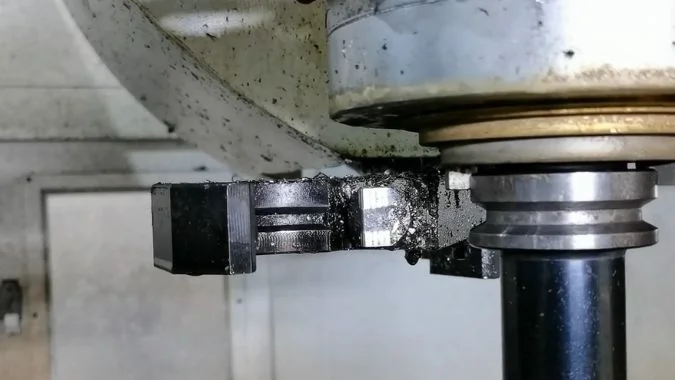
The Serial Safety Handshake
An automatic tool changer cannot safely skip confirmation steps. The spindle must stop and reach its orientation position. The machine axes must reach the tool change coordinates. The unclamp signal must arrive before tool removal. The clamp signal must arrive before arm return or spindle movement.
Tool pots, arms, and magazines also use position switches. The controller may check the safety door, air pressure, hydraulic pressure, and air-blow completion. A programmable machine controller may add a protection delay and a dual-channel safety check. No movement starts until the required conditions become true.
| Waiting point | Required confirmation | Common delay source |
|---|---|---|
| Spindle preparation | Stop and orientation complete | Slow deceleration or M19 timer |
| Axis positioning | Change point reached | Long travel or low rapid rate |
| Tool release | Unclamp confirmed | Slow cylinder or pressure loss |
| Tool insertion | Clamp confirmed | Sensor adjustment or contamination |
| Magazine movement | Pot and arm position confirmed | Late limit-switch trigger |
| Machine protection | Door and pressure signals valid | Fixed PMC delay |
Safe Ways to Reduce Waiting
The best improvement does not remove necessary interlocks. It shortens the physical action, improves signal timing, and overlaps actions that do not conflict. Magazine pre-selection can occur during cutting. Tool-pot rotation can occur while the spindle travels toward the change point. Pot return may occur after the control has acknowledged a successful exchange and machining has resumed.
Fixed delays should not govern every tool. A long probe or heavy holder may need a slower sequence, while a standard tool can use the normal fast sequence. Adjustable tool categories prevent one unusual tool from slowing the whole magazine.
Acceptance testing should include a timing chart. The chart should separate spindle orientation, axis travel, tool release, arm motion, clamping, and signal confirmation. This method reveals whether the delay comes from actual motion or from a controller waiting for late feedback.
How to Match Tool Magazine Capacity with Spindle Speed?
Choosing the largest available magazine can harm productivity when its mass, search time, and control logic cannot support a high-speed spindle’s short cutting cycle.
Tool magazine capacity should match the process tool list, spindle speed, tool weight, and target chip-to-chip time. High-speed work usually favors a low-inertia disk magazine, while heavy multi-process work may justify a large chain or matrix magazine with pre-selection.
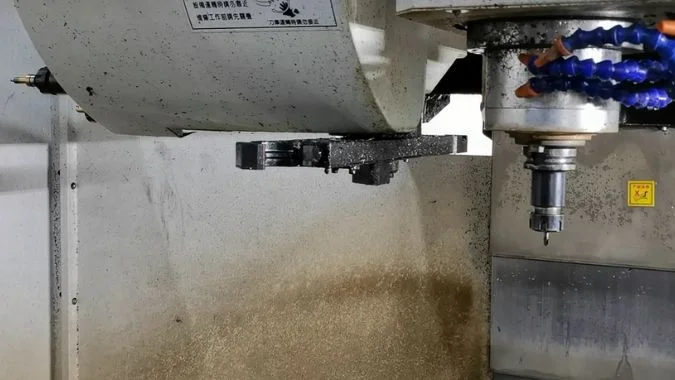
Start with the Spindle and Process
Spindle specifications establish the limits for the tool magazine. The selection process should record maximum speed, taper, holder type, tool weight, tool length, adjacent tool diameter, and balance grade. It should also record spindle stop and orientation time.
The process plan supplies the second group of limits. Important data includes the number of tool changes per part, the shortest cutting operation, the required tool list, and the target chip-to-chip time. Chip-to-chip time matters more than an isolated tool-to-tool demonstration because it includes the real interruption to production.
Capacity should cover the process tool list and normally allow two to four spare positions. Excess capacity increases moving mass and may increase the farthest search distance without adding useful production value.
Match the Magazine to the Operating Condition
| Operating condition | Typical spindle | Suitable magazine | Poor match |
|---|---|---|---|
| High-frequency drilling or tapping | 12,000–24,000 rpm8 | 16–30-tool cam disk with pre-selection9 | Large chain magazine without pre-selection |
| Medium-speed general machining | 8,000–15,000 rpm | 24–40-tool random-address disk | Capacity far above the tool list |
| Heavy multi-process work | 6,000–10,000 rpm | 60-tool or larger chain or matrix | Light disk magazine carrying oversized tools |
| Flexible production line | Based on fastest part | Shared-capacity random management | Large fixed-address magazine |
A high-speed spindle usually works best with a low-inertia manipulator disk magazine. A large chain or matrix magazine suits heavy cutting and processes that genuinely require many tools. Such a magazine should support random addressing, bidirectional shortest-path search, and in-process pre-selection.
Verify Performance Before Purchase
The supplier should provide full-load data rather than an empty-magazine sample. Required figures should include nearby-tool, far-tool, and heavy-tool tool-to-tool and chip-to-chip times. The supplier should also provide motor specifications, reflected inertia, acceleration settings, and a list of actions that can overlap.
A matching design passes four practical checks:
- Every tool meets spindle and magazine limits for weight, length, diameter, balance, and speed.
- Pre-selection keeps far-tool chip-to-chip time close to nearby-tool performance.
- Standard tools do not use heavy-tool acceleration and deceleration settings.
- Interlock waiting does not rise sharply as magazine capacity increases.
A failed check calls for a different magazine type, capacity, drive, or control strategy. Lowering spindle speed only hides the mismatch and reduces the value of the machine.
Conclusion
A matched tool magazine protects cycle time through suitable capacity, optimized search logic, controlled inertia, short movement paths, and fast but complete safety handshakes.
-
"Doosan Fanuc Spindle Angle Orientation | M19 S Setup …", https://industrialmonitordirect.com/blogs/knowledgebase/doosan-cnc-spindle-angle-orientation-m19-s-command-setup-guide?srsltid. Spindle orientation times in modern machining centers typically range from under 1 second to approximately 3 seconds, depending on spindle speed, deceleration parameters, and positioning accuracy requirements. Evidence role: general_support; source type: research. Supports: typical spindle orientation times in CNC machining centers. Scope note: Actual times vary significantly by machine class, spindle type, and control system configuration ↩
-
"Is Larger Tool Magazine Capacity Always Better for CNC …", https://jmcncmachine.com/is-larger-tool-magazine-capacity-always-better-for-cnc-machining-center/. Large-capacity chain or carousel tool magazines can require indexing times ranging from several seconds for adjacent tools to 20-40 seconds for the farthest tool positions, depending on magazine size and drive system design. Evidence role: general_support; source type: research. Supports: indexing times for large-capacity chain-type tool magazines. Scope note: Actual indexing time depends heavily on magazine capacity, motor power, acceleration limits, and whether shortest-path or unidirectional indexing is used ↩
-
"Dijkstra’s algorithm", https://en.wikipedia.org/wiki/Dijkstra%27s_algorithm. Bidirectional shortest-path indexing can reduce average magazine rotation time by approximately 50% compared to unidirectional indexing, particularly in large-capacity systems where the farthest tool is more than 180 degrees away. Evidence role: mechanism; source type: research. Supports: the optimization benefits of shortest-path indexing strategies in rotary tool storage systems. Scope note: The actual benefit depends on tool selection patterns, magazine capacity, and whether the control system supports pre-selection during machining ↩
-
"10.7 Newton’s Second Law for Rotation – UCF Pressbooks", https://pressbooks.online.ucf.edu/osuniversityphysics/chapter/10-7-newtons-second-law-for-rotation/. This is the rotational analog of Newton’s second law, expressing that net torque equals the product of moment of inertia and angular acceleration. Evidence role: definition; source type: encyclopedia. Supports: the mathematical relationship between torque, moment of inertia, and angular acceleration. ↩
-
"Resonant Suppression Method Based on PI control for Serial …", https://pmc.ncbi.nlm.nih.gov/articles/PMC10358500/. Natural frequency in mechanical systems is inversely proportional to the square root of inertia, with higher inertia lowering the resonant frequency and reducing system bandwidth. Evidence role: mechanism; source type: education. Supports: the relationship between system inertia and natural frequency in mechanical systems. ↩
-
"Breaking the old rules of inertia matching for servo …", https://www.motioncontroltips.com/breaking-the-old-rules-of-inertia-matching/. High load inertia reduces servo system stiffness and lowers resonant frequencies, making the system more susceptible to mechanical resonances and requiring reduced controller gains to maintain stability. Evidence role: mechanism; source type: education. Supports: the effect of high load inertia on servo system stability and resonance characteristics. ↩
-
"Oversize servo to avoid tuning? : r/PLC", https://www.reddit.com/r/PLC/comments/17np7sp/oversize_servo_to_avoid_tuning/. When load inertia significantly exceeds recommended ratios, servo engineers typically reduce proportional and velocity gains while implementing acceleration feedforward and softer S-curve profiles to prevent overshoot and oscillation. Evidence role: mechanism; source type: education. Supports: standard servo tuning practices for high-inertia loads. Scope note: Specific tuning strategies depend on the servo drive architecture and application requirements for settling time and accuracy ↩
-
"Speeds and feeds", https://en.wikipedia.org/wiki/Speeds_and_feeds. High-speed machining centers for aluminum and light materials commonly operate at spindle speeds of 10,000-24,000 rpm, with specialized high-frequency drilling and tapping operations sometimes exceeding 30,000 rpm. Evidence role: general_support; source type: research. Supports: typical spindle speed ranges for high-frequency drilling and tapping operations. Scope note: Optimal speeds depend heavily on material type, tool diameter, and specific operation requirements ↩
-
"Disc-type vs Umbrella-type Tool Magazine", https://cncwmt.com/qa/disc-type-vs-umbrella-type-tool-magazine-comprehensive-selection-guide/. Disk-type and cam-driven tool magazines commonly range from 12 to 40 tool positions, with 16-30 tools being typical for general-purpose machining centers, offering lower inertia than chain magazines of similar capacity. Evidence role: general_support; source type: other. Supports: typical tool capacity ranges for cam disk or manipulator-style tool magazines. Scope note: Capacity varies significantly by machine size and manufacturer design philosophy ↩

Chris Lu
Leveraging over a decade of hands-on experience in the machine tool industry, particularly with CNC machines, I'm here to help. Whether you have questions sparked by this post, need guidance on selecting the right equipment (CNC or conventional), are exploring custom machine solutions, or are ready to discuss a purchase, don't hesitate to CONTACT Me. Let's find the perfect machine tool for your needs.